Introduction
If you’ve spent any time on LinkedIn lately, you already know that generative AI and AWS are practically finishing each other’s sentences. Amazon Bedrock, SageMaker JumpStart, and Q Business have quietly turned AWS into one of the busiest playgrounds for enterprise AI experimentation. But here’s the real question professionals are asking in 2026: which of these trends actually matter for your career, and which are just noise? This blog cuts through the hype and lays out exactly where generative AI on AWS is heading — and why pairing that knowledge with an aws solution architect certification might be the smartest move you make this year.
Why Cloud Professionals Can’t Ignore Generative AI Anymore
A few years ago, generative AI felt like a side project for data scientists. Now it’s baked into procurement decisions, product roadmaps, and hiring criteria across nearly every industry. AWS re: Invent sessions are increasingly dominated by generative AI use cases — from customer service copilots to automated code review pipelines. What’s changed is scale: companies aren’t just testing chatbots anymore; they’re running production workloads that touch millions of customers. For architects and engineers, this shift means the old playbook of “just know EC2 and S3 well” no longer cuts it. Employers want people who understand how foundation models integrate with existing cloud infrastructure, how to control costs at scale, and how to secure data pipelines feeding these models.
Amazon Bedrock Is Becoming the Default Entry Point
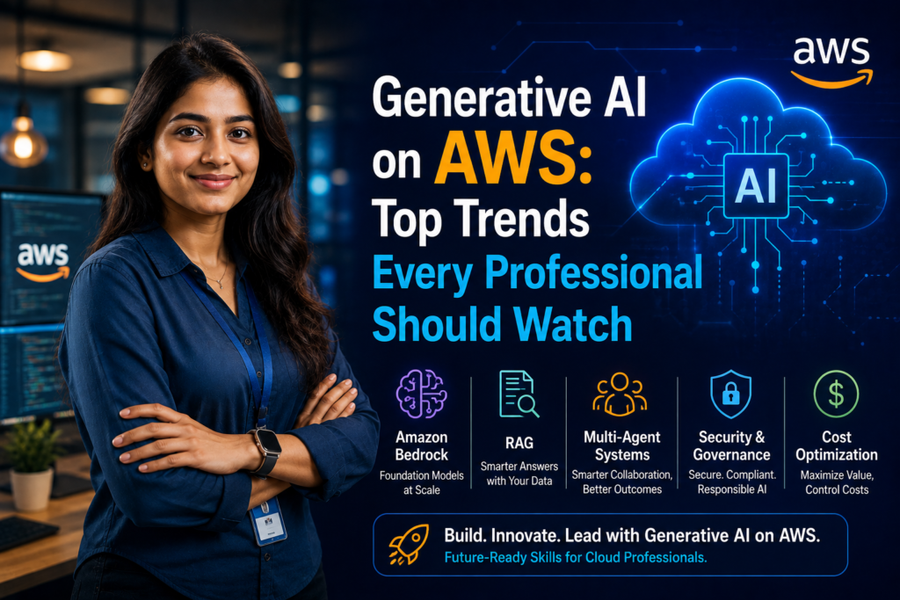
If there’s one service defining AWS’s generative AI story right now, it’s Bedrock. Rather than forcing teams to train models from scratch, Bedrock gives access to multiple foundation models — Anthropic’s Claude, Meta’s Llama, Amazon’s own Titan and Nova models — through a single, unified API. This “model marketplace” approach means companies can swap models based on cost, latency, or accuracy needs without rebuilding their entire application.
What’s interesting is how this changes the skill requirements for cloud professionals. You no longer need deep machine learning research expertise to deploy generative AI; you need strong architectural judgment about latency budgets, throughput limits, and multi-model orchestration. That’s precisely the kind of judgment tested and sharpened through an AWS Solutions Architect Certification track, which forces candidates to think in terms of trade-offs rather than just tool familiarity.
Retrieval-Augmented Generation Is Now a Baseline Expectation
Retrieval-Augmented Generation, or RAG, has moved from “nice to have” to “assumed default” in almost every serious generative AI project on AWS. Instead of relying purely on a model’s pretrained knowledge, RAG architectures pull real-time, proprietary data from sources like Amazon Kendra, OpenSearch, or vector databases such as Amazon Aurora with pgvector support. The result is answers that are accurate, current, and grounded in a company’s actual documents rather than generic internet knowledge.
Think of a healthcare provider building an internal assistant that answers questions using its own clinical guidelines instead of whatever a public model happened to learn during training. That’s RAG in action, and AWS has made building these pipelines dramatically easier through managed services. Professionals who understand vector storage, embedding models, and retrieval pipelines are becoming some of the most sought-after hires in cloud teams today.
Multi-Agent Systems Are Replacing Single-Prompt Chatbots
Single-turn chatbots are old news. The trend gaining serious traction in 2026 is multi-agent orchestration, where several specialized AI agents collaborate to complete complex tasks — one agent researches, another drafts, another verifies, and a coordinator agent manages the whole workflow. Amazon Bedrock Agents now supports this pattern natively, letting developers chain reasoning steps, call external APIs, and maintain memory across long-running tasks.
This matters for professionals because designing multi-agent systems requires the same architectural thinking used in distributed systems — fault tolerance, state management, and cost control across multiple invocations. It’s not just a data science problem anymore; it’s a cloud architecture problem, which again circles back to why solid infrastructure fundamentals remain non-negotiable.
Cost Governance Is Becoming a Career-Defining Skill
Here’s something rarely discussed in flashy AI demos: generative AI workloads can get expensive fast if nobody’s watching the meter. Token-based pricing, GPU-backed inference endpoints, and always-on vector databases add up quickly, and finance teams are pushing back hard on runaway AI budgets.
Build, Innovate, lead with Generative AI on AWS
Difference Between Traditional Cloud Architecture Skills and Generative AI Architecture Skills
Aspect | Traditional Cloud Architecture | Generative AI Architecture |
Core Focus | Compute, storage, networking design | Model orchestration, prompt design, retrieval pipelines |
Cost Model | Predictable, usage-based (EC2 hours, storage GB) | Variable, token-based, GPU inference pricing |
Key Services | EC2, VPC, RDS, S3 | Bedrock, SageMaker, Kendra, OpenSearch |
Security Priority | Network isolation, IAM policies | Data leakage prevention, prompt injection defense |
Skill Validation | AWS certifications, hands-on labs | Certifications plus applied AI project experience |
Career Entry Point | Infrastructure and DevOps roles | AI/ML engineering and architecture roles |
Why Certification Still Matters in an AI-First AWS World
It’s tempting to assume that generative AI tools make deep cloud knowledge less relevant — after all, if an AI copilot can write your Terraform script, why bother learning the fundamentals? But that logic doesn’t hold up under scrutiny. Someone still has to validate the AI’s output, catch the misconfigured security group, and design systems that scale safely. The AWS certification benefits here are concrete: certified professionals consistently report faster promotions, stronger salary negotiations, and easier transitions into AI-adjacent architecture roles because employers trust that the fundamentals are solid.
Responsible AI and Guardrails Are No Longer Optional
Regulatory scrutiny around AI is intensifying globally, and AWS has responded with tools like Bedrock Guardrails, which let teams filter harmful content, block sensitive topics, and reduce hallucinations before responses reach end users. This isn’t just a compliance checkbox — it’s becoming a genuine differentiator for enterprise clients choosing between vendors. Professionals who understand how to configure these guardrails, test for bias, and document AI decision-making processes are positioning themselves for leadership roles in AI governance, a function almost every large enterprise is scrambling to build out right now.
Bringing It All Together
Generative AI on AWS isn’t slowing down, and honestly, it’s not going to. What separates professionals who ride this wave successfully from those who get left behind isn’t chasing every new model release—it’s mastering the underlying architecture that makes these tools trustworthy, secure, and cost-effective at scale. Whether you’re deep into Bedrock experiments or just starting to explore RAG pipelines, grounding your skills with an AWS Certified Solutions Architect credential gives you the structural foundation that AI trends alone can’t provide. The tools will keep changing; solid architectural judgment won’t go out of style.
Written by
Aabiance Technology
Expert instructor and certified professional with extensive experience training working professionals for global certifications including PMP, AWS, CSM, and PSM.