Introduction
If you’ve ever stared at the AWS certification page wondering which badge actually moves the needle on your résumé, you’re not alone. Thousands of IT professionals ask the same question every month, and the honest answer is this: reading whitepapers alone won’t get you certified or job-ready. What separates candidates who pass on the first attempt from those who don’t is practice inside the actual AWS console. This guide walks you through a realistic prep roadmap built around hands-on projects, not just flashcards, so you can earn your AWS Solution Architect Certification with confidence and actually use what you learn on the job.
Why This Certification Still Matters in 2026
Cloud hiring hasn’t cooled down — if anything, companies are more selective about who they trust with production infrastructure. Recruiters increasingly filter resumes for cloud credentials before even scheduling interviews, and AWS remains the dominant platform across startups and enterprises alike. Understanding the AWS Certification Benefits early in your prep helps you stay motivated when the material gets tough, because you’re not memorizing acronyms for their own sake — you’re building toward a role that pays 15–25% more on average than equivalent non-certified positions, according to recent industry salary surveys. Beyond compensation, certified professionals often get first pick on cloud migration projects, DevOps initiatives, and architecture reviews, simply because managers trust the validation that AWS has already done for them.
Choosing the Right Certification Path Before You Start
Not everyone needs the same exam. AWS offers foundational, associate, professional, and specialty tracks, and picking the wrong one wastes months. If you’re new to cloud but comfortable with basic IT concepts, Cloud Practitioner is a sensible entry point. But if your goal is architecture, deployment strategy, or infrastructure design, the associate-level AWS Solutions Architect certification is what employers actually search for on job boards. It tests your ability to design resilient, cost-optimized systems using services like EC2, S3, VPC, RDS, and IAM — skills that translate directly into real workplace tasks rather than trivia.
Building a Study Plan That Actually Sticks
Most people fail not because the material is impossible, but because their study plan collapses after week two. A better approach is to block your prep into three phases: concept learning (2–3 weeks), hands-on labs (3–4 weeks), and practice exams (1–2 weeks). During the concept phase, use a structured course rather than scattered YouTube videos — consistency matters more than the specific instructor you choose. During the labs phase, this is where an aws certified solutions architect candidate really separates from a passive learner. You should be logging into the AWS Free Tier account daily, not just watching someone else click buttons on screen.
The Hands-On Projects That Make the Difference
Theory gets you through multiple-choice questions, but projects teach you why the “correct” answer is correct. Here are five projects worth building before exam day:
First, deploy a static website using S3 and CloudFront with a custom domain through Route 53 — this teaches you storage, CDN caching, and DNS routing in one exercise. Second, build a three-tier web application with EC2 instances behind an Application Load Balancer, connected to an RDS database in a private subnet, which forces you to understand VPC design and security groups properly. Third, set up an auto-scaling group with CloudWatch alarms so you experience how AWS reacts to real traffic spikes rather than just reading about elasticity. Fourth, configure IAM roles and policies for a multi-user environment to internalize the principle of least privilege, which shows up constantly on the exam. Fifth, build a serverless application using Lambda, API Gateway, and DynamoDB—a pattern that’s increasingly common in real job interviews for anyone pursuing the AWS Certified Solutions Architect credential.
Each of these projects maps directly to exam domains around resilient architectures, high-performing designs, secure applications, and cost optimization. Recruiters and hiring managers also love seeing these projects documented on GitHub or a personal portfolio site, because it proves you can do the work, not just answer questions about it.
Common Mistakes Candidates Make During Prep
A surprisingly large number of candidates over-invest in memorizing service limits and under-invest in understanding decision-making scenarios. The exam rarely asks “what is the maximum size of an S3 object” — it asks “which architecture minimizes cost while maintaining availability across two regions.” That’s a reasoning question, not a fact-recall question. Another common mistake is skipping the AWS Well-Architected Framework, which quietly underpins nearly a third of scenario-based questions. Finally, many people schedule the exam too early, before they’ve done a single full-length timed practice test, which leads to unnecessary anxiety and rushed answers.
Understanding the Real-World Benefits Beyond the Badge
It’s worth pausing on why professionals push through weeks of late-night labs for this. The AWS certification benefits extend past the interview stage. Certified architects often get invited into pre-sales conversations, client architecture reviews, and internal centers of excellence — visibility that non-certified colleagues rarely get early in their careers. There’s also a compounding effect: once you hold one AWS credential, pursuing the next one (DevOps Engineer, Security Specialty, or the Professional-level Solutions Architect) becomes noticeably easier because your foundational knowledge is already solid.
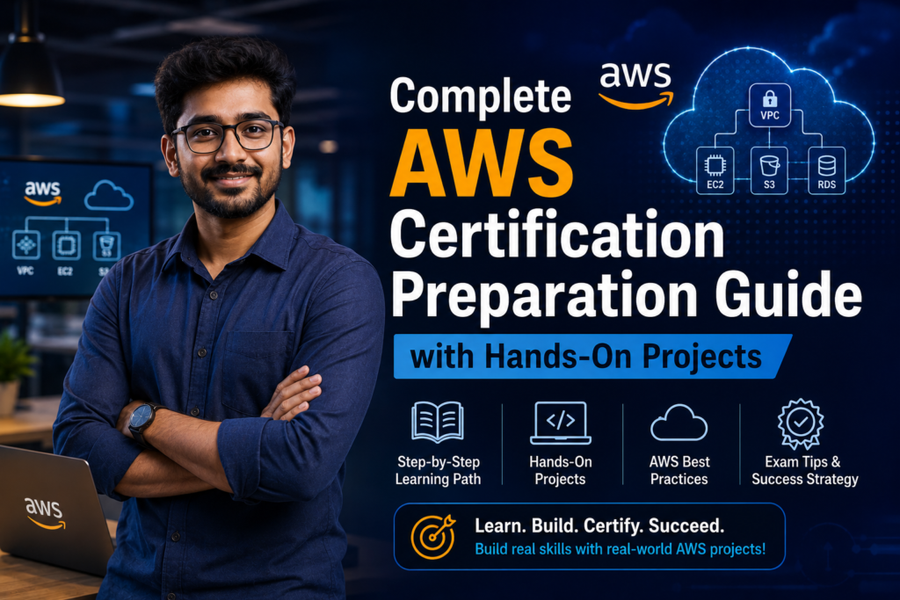
Learn, Build, Certify, Succeed.
AWS Certified Solutions Architect vs Other Cloud Architect Roles
Aspect | AWS Certified Solutions Architect | General Cloud Architect Role |
Focus | AWS-specific services and best practices | Multi-cloud or platform-agnostic design |
Validation | Standardized AWS exam | Employer-defined experience and interviews |
Entry point | Associate-level, achievable in 2–3 months | Usually requires 3+ years of prior experience |
Career use | Proof of AWS technical competency | Broader architectural decision-making authority |
Renewal | Recertify every 3 years | No formal renewal; skills assessed continuously |
Final Weeks Before the Exam
In the last two weeks, shift entirely toward timed practice exams and review the explanations for every wrong answer, even the ones you guessed correctly. Rebuild any lab you struggled with from memory, without following a tutorial. This single habit — rebuilding without hand-holding — is often the difference between a 680 and a 780 score. Book the exam once you’re consistently scoring above 80% on practice tests, and don’t wait for “perfect” readiness, because it rarely arrives.
Wrapping It Up
Earning your AWS Solution Architect Certification isn’t about cramming service names the night before the exam — it’s about building real infrastructure, breaking it, fixing it, and understanding why AWS designed things the way they did. Combine structured learning with the five hands-on projects above, respect the exam’s scenario-based nature, and you’ll walk in prepared rather than hopeful. The credential opens doors, but the hands-on skill is what keeps you in the room once you’re there.
Written by
Aabiance Technology
Expert instructor and certified professional with extensive experience training working professionals for global certifications including PMP, AWS, CSM, and PSM.