Introduction
If you’ve ever wondered whether a three-letter credential can actually change your paycheck and your career trajectory, the answer with PMP is a resounding yes. Project Management Professional certification is one of the most respected credentials in the corporate world, and 2026 looks like a particularly good year to earn it. Organizations across IT, construction, healthcare, and finance are hunting for certified project managers who can bring structure to increasingly complex, cross-functional teams. This guide breaks down exactly what the PMP means for your salary, who qualifies, and how to actually get there without wasting time or money on the wrong training path.
Why PMP Still Matters in a Job Market Full of Buzzwords
Every year, a new acronym promises to be the “next big thing” in career credentials. PMP has outlasted most of them because it’s tied to a measurable skill: the ability to deliver projects on time, within scope, and on budget. Hiring managers don’t just see a certificate; they see someone who understands risk management, stakeholder communication, and agile-hybrid delivery models. In 2026, with AI tools automating routine scheduling and reporting tasks, the human skills PMP certifies—leadership, negotiation, adaptive planning—are becoming more valuable, not less. Companies are no longer just asking “can you manage a project”; they’re asking “can you manage ambiguity,” and that’s precisely what PMP training instills.
PMP Certification Salary Trends: What the Numbers Actually Say
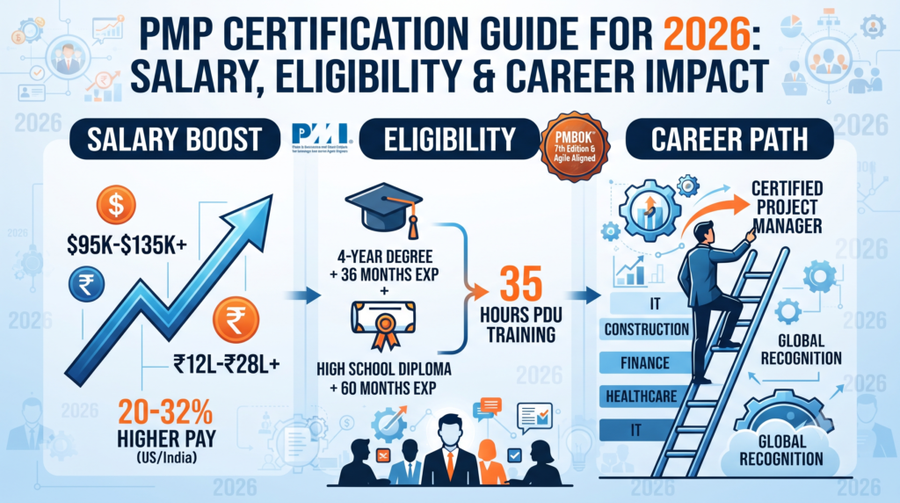
Salary is usually the first question people ask, and rightly so. According to PMI’s own Earning Power research and multiple industry salary surveys, PMP-certified professionals in the United States typically earn between 20% and 32% more than their non-certified peers in similar roles. In India, certified project managers often see annual packages ranging from ₹12 lakhs to ₹28 lakhs depending on industry and experience, while in the US the range commonly falls between $95,000 and $135,000 annually for mid-to-senior roles. Sectors like IT, pharmaceuticals, and infrastructure tend to pay the highest premiums because project failures in these industries carry heavier financial and regulatory consequences. It’s worth noting that salary isn’t just about holding the certificate—it’s about pairing it with real project experience, which is exactly why PMI insists on a minimum work-hour requirement before you can even sit for the exam.
Eligibility Criteria You Actually Need to Meet
PMI splits eligibility into two tracks based on your educational background. If you hold a four-year degree, you’ll need 36 months of leading projects within the past eight years, along with 35 hours of project management education. If your highest qualification is a high school diploma or associate degree, the bar is a bit higher: 60 months of project leadership experience plus the same 35 hours of training. That 35-hour requirement is non-negotiable, and this is exactly where choosing the best online project management certificate program matters—it must be PMI-approved, or your application will be bounced during the audit process. A lot of first-time applicants underestimate how strict PMI is about documenting project hours, so it’s smart to start logging your project history well before you plan to submit your application.
Choosing the Right Training: Not All Courses Are Created Equal
This is where most candidates either save themselves months of frustration or set themselves up for a failed first attempt. A PMP certification training course online should do three things well: cover the full PMBOK framework alongside agile and hybrid approaches, provide realistic practice exams that mirror the actual test’s difficulty, and include an instructor or mentor support system for doubt-clearing. Cheap, self-paced video libraries without any interactive component tend to leave gaps, especially around situational judgment questions that make up a huge chunk of the current exam pattern. When comparing providers, look for ones that update their material based on PMI’s latest Examination Content Outline rather than reusing content from five years ago—PMI revised its exam structure significantly in recent cycles, and outdated courses simply don’t prepare you for what you’ll actually face.
Why PMP Still Matters in a Job Market Full of Buzzwords
Every year, a new acronym promises to be the “next big thing” in career credentials. PMP has outlasted most of them because it’s tied to a measurable skill: the ability to deliver projects on time, within scope, and on budget. Hiring managers don’t just see a certificate; they see someone who understands risk management, stakeholder communication, and agile-hybrid delivery models. In 2026, with AI tools automating routine scheduling and reporting tasks, the human skills PMP certifies—leadership, negotiation, adaptive planning—are becoming more valuable, not less. Companies are no longer just asking “can you manage a project”; they’re asking “can you manage ambiguity,” and that’s precisely what PMP training instills.
PMP Certification Salary Trends: What the Numbers Actually Say
Salary is usually the first question people ask, and rightly so. According to PMI’s own Earning Power research and multiple industry salary surveys, PMP-certified professionals in the United States typically earn between 20% and 32% more than their non-certified peers in similar roles. In India, certified project managers often see annual packages ranging from ₹12 lakhs to ₹28 lakhs depending on industry and experience, while in the US the range commonly falls between $95,000 and $135,000 annually for mid-to-senior roles. Sectors like IT, pharmaceuticals, and infrastructure tend to pay the highest premiums because project failures in these industries carry heavier financial and regulatory consequences.
Eligibility Criteria You Actually Need to Meet
PMI splits eligibility into two tracks based on your educational background. If you hold a four-year degree, you’ll need 36 months of leading projects within the past eight years, along with 35 hours of project management education. If your highest qualification is a high school diploma or associate degree, the bar is a bit higher: 60 months of project leadership experience plus the same 35 hours of training. That 35-hour requirement is non-negotiable, and this is exactly where choosing the best online project management certificate program matters—it must be PMI-approved, or your application will be bounced during the audit process. A lot of first-time applicants underestimate how strict PMI is about documenting project hours, so it’s smart to start logging your project history well before you plan to submit your application.
Choosing the Right Training: Not All Courses Are Created Equal
This is where most candidates either save themselves months of frustration or set themselves up for a failed first attempt. A PMP certification training course online should do three things well: cover the full PMBOK framework alongside agile and hybrid approaches, provide realistic practice exams that mirror the actual test’s difficulty, and include an instructor or mentor support system for doubt-clearing. Cheap, self-paced video libraries without any interactive component tend to leave gaps, especially around situational judgment questions that make up a huge chunk of the current exam pattern. When comparing providers, look for ones that update their material based on PMI’s latest Examination Content Outline rather than reusing content from five years ago—PMI revised its exam structure significantly in recent cycles, and outdated courses simply don’t prepare you for what you’ll actually face.
PMP Certification Guide For 2026: Salary, Eligibility and Career Impact
Comparing Your Training Options
Feature | Self-Paced Video Course | Live Instructor-Led Course | Bootcamp/Intensive Program |
Best for | Disciplined self-learners | Working professionals needing structure | Fast-track exam preparation |
Typical Duration | 4–8 weeks (flexible) | 5–6 weeks (fixed schedule) | 5–10 days |
Mentor Support | Limited or none | Regular live doubt sessions | Intensive daily support |
Practice Exams Included | Sometimes basic | Usually PMI-aligned mock tests | Extensive, exam-simulated |
Cost Range | Lower | Moderate | Higher |
Pass Rate Impact | Variable | Generally higher | Highest, if attended fully |
How PMP Exam Training Online Has Evolved for 2026
Online learning isn’t what it was even three years ago. Today’s PMP exam training online platforms use adaptive learning engines that identify your weak knowledge areas—say, procurement management or earned value calculations—and adjust your practice sessions accordingly. Many providers now include AI-based mock exam analysis that predicts your readiness score before you even book your test date. This matters because PMI’s exam fee is non-trivial, and a failed attempt costs both money and momentum. The smarter approach in 2026 is to treat your first practice exam attempt as diagnostic, not a pass/fail moment, and then use targeted online training modules to close specific gaps rather than re-studying everything from scratch.
Career Paths That Open Up After Certification
Once certified, professionals typically move into roles like Senior Project Manager, Program Manager, PMO Lead, or even Portfolio Director within three to five years. What’s less talked about is the lateral mobility PMP creates—certified professionals often pivot from technical delivery roles into business operations, consulting, or product management because the certification signals structured thinking regardless of domain. Some professionals also use PMP as a stepping stone toward PgMP (Program Management Professional) or PfMP (Portfolio Management Professional) later in their careers, building a credential ladder that keeps compounding their market value.
Making the Right Investment Decision
Before enrolling anywhere, it helps to be honest about your learning style and schedule constraints. If you’re balancing a full-time job, a self-paced online project management certificate program with recorded sessions might fit better than a rigid live-class schedule. If you thrive on accountability and live discussion, invest in a course with scheduled cohorts and instructor access. Either way, verify that the provider is a PMI Authorized Training Partner (ATP)—this isn’t just a formality; it directly affects whether your 35 contact hours count toward your application.
Written by
Aabiance Technology
Expert instructor and certified professional with extensive experience training working professionals for global certifications including PMP, AWS, CSM, and PSM.