ITIL® Foundation (Version 5) Certification Training Course in Chennai

Learn the new ITIL® Version 5 framework for digital products, services and AI-enabled operations in 2 focused days.

Live instructor-led training — online across India or in a Chennai classroom
Full ITIL® Foundation (Version 5) syllabus: 12 modules, 2 days, 16 hours
Hands-on exercises: Four Dimensions analysis, value-stream mapping, continual improvement
Scenario-based mock exams built to the real 40-question, 60-minute format
No prerequisites — ideal for beginners and experienced IT professionals alike
Duration 2 days · 16 hrs
Exam Format 40 MCQ · 60 min
Pass Mark 65% (26 / 40)
Prerequisites None Required
Delivery Mode Online · Chennai · Corp
Want to Train Your Team? Request Corporate Quote or call +91 89255 99449

Talk to an ITIL® Advisor

Get upcoming batch dates, syllabus, and official PeopleCert exam details.

100% confidential. Authorized PeopleCert guidance.
Prefer to speak now? +91 89255 99449

ITIL® Foundation Version 5 Course at a Glance

Everything you need to know about the new ITIL® Version 5 Foundation programme.

Detail Information
Course ITIL® Foundation (Version 5)
Level Foundation (Entry-Level Credential)
Course Plan Two days across 12 modules (16 intensive hours)
Suitable For IT support, service desk, operations, service management, project and product professionals
Prior Certification Not required for Foundation — open to all backgrounds
Training Mode Live Online (Virtual Classroom) · Classroom in Chennai · Corporate In-House
Next Class Upcoming Saturday (10:00 AM – 5:00 PM IST)
Exam Voucher Official PeopleCert exam voucher available / bundled with course package

What Is ITIL® V5 Certification?

Key Takeaway

ITIL® V5 certification — ITIL® Foundation (Version 5) — is the entry-level credential in the latest edition of ITIL®, the world’s most widely adopted framework for IT and digital service management. Awarded by PeopleCert, it proves you understand how organisations co-create value through digital products and services, using the ITIL® Value System, four dimensions, guiding principles and management practices.

ITIL® Version 5 builds on ITIL® 4 and widens its scope from IT service management to digital product and service management. It is designed for how organisations work today: cloud platforms, automation, cross-functional product teams and AI-enabled operations. The Foundation certificate gives you a shared vocabulary and a practical model you can apply in your first week back at work — whether you sit on a service desk, run infrastructure, own a product backlog or lead a transformation programme.

The Foundation exam is the gateway to every higher ITIL® Version 5 qualification, so it is the right starting point whether you are new to ITSM or refreshing an older ITIL® credential.

Why does ITIL® Version 5 matter for today's IT teams?

Digital teams need to understand both the products they build and the services people depend on. Version 5 expands the framework's focus on integrated digital product and service management, with greater relevance to AI-enabled organisations.

Connect work with business value

Understand how service activities contribute directly to customer needs, business outcomes, and measurable ROI rather than just managing tickets.

See the complete workflow

Use value-stream thinking to recognise handovers, eliminate bottlenecks, remove delays, and uncover systemic opportunities for continual improvement.

Understand the context for automation & AI

Consider people, risk, compliance, and governance when discussing AI-enabled operations and automated workflows.

Improve cross-team collaboration

Build a shared vocabulary across support, DevOps, cloud engineering, product management, and business stakeholders.

What’s New in ITIL® Version 5? (ITIL® 5 vs ITIL® 4)

If you learned ITIL® 4, most of the thinking will feel familiar — value co-creation, guiding principles and continual improvement remain. What changes is scope and emphasis:

Area ITIL® 4 Foundation ITIL® Foundation (Version 5)
Core Focus IT service management (ITSM) Digital product and service management
Operating Model Service Value System (SVS) and service value chain ITIL® Value System with an end-to-end product and service lifecycle plus value chain activities
Artificial Intelligence (AI) Largely out of scope Dedicated coverage of ITIL® and artificial intelligence — AI-enabled operations, governance and human–technology collaboration
Value Streams Introduced at a conceptual level Greater emphasis on value-stream identification, mapping, and active management
Other Frameworks Discussed as general context Explicit guidance on working alongside DevOps, Agile, PRINCE2, and modern site reliability engineering
Exam Format 40 MCQ · 60 min · 65% 40 MCQ · 60 min · 65% · closed book — same proven format with refreshed, contemporary content
Bottom line: ITIL® 4 certifications remain valid. ITIL® Version 5 is the current edition employers will increasingly ask for, especially for roles that touch digital products, cloud, automation, and AI.

Already ITIL® 4 Certified? Bridge or Full Foundation?

PeopleCert offers two ways into ITIL® Version 5. Choose the one that fits your background:

ITIL® Foundation Bridge (Version 5)

Fast-track upgrade path exclusively for verified ITIL® 4 credential holders.

  • Best for Professionals who already hold an eligible ITIL 4 credential
  • Prerequisite Eligible ITIL 4 certificate (Proof required)
  • Exam Format 20 questions · 30 minutes · Closed book
  • Pass Mark 65% (13 / 20 correct)
  • Our Course Bridge Batch available on request
Ask About Bridge Batch

Not sure which option is right for you?

Speak with an Aabiance ITIL advisor to verify your prior credentials and choose the best track.

Ask an Advisor

Who Should Attend This ITIL® V5 Foundation Course?

This course is built for anyone who designs, delivers, supports, or improves digital products and services:

IT Professional

Gain a framework that connects your daily tickets, changes, and releases to tangible business value.

Service Desk & Support

Master clear incident, service request, and problem practices — and create a structured path beyond L1/L2 support.

IT Operations Professional

Adopt monitoring, event, change enablement, and deployment practices that proactively reduce outages.

IT / Service Manager

Implement service levels, governance, and continual improvement to run modern services predictably and efficiently.

Project & Product Professional

Understand the product and service lifecycle — ensuring what you build is seamlessly operated, supported, and improved.

Business Analyst

Leverage value streams and value-stream mapping techniques to identify delays and eliminate operational bottlenecks.

Digital Transformation Member

Acquire a shared operational model for cloud adoption, workflow automation, and AI-enabled organizational change.

Career Starter in ITSM

Secure a globally recognized first credential with no prerequisites, opening doors in global MNCs and IT enterprises.

Not sure whether this course fits your role?

Get Free Course Guidance

What Will You Learn?

By the end of this 2-day training, you will be equipped to:

Purpose of ITIL & Service Management

Explain the core mission of ITIL and how modern service management connects technology to business outcomes.

Value Co-Creation

Describe how service providers, customers, consumers, and external stakeholders actively co-create value.

Service Management Terminology

Clearly distinguish products, services, outputs, outcomes, costs, risks, utility, and warranty.

The Four Dimensions

Explain the four dimensions of product and service management and assess how they work holistically together.

ITIL® Value System (IVS)

Describe the purpose, components, and coordinated activities of the end-to-end ITIL® Value System.

7 Guiding Principles

Apply the seven ITIL guiding principles to evaluate real-world workplace situations and guide decisions.

Product & Service Lifecycle

Explain product and service lifecycle thinking across Discover, Design, Acquire, Build, Transition, Operate, Deliver, and Support.

Value-Stream Mapping

Identify value streams and explain how value-stream mapping exposes handovers, wait times, and improvement spots.

Management Practices

Describe how introductory ITIL management practices ensure reliable service delivery and support operations.

Continual Improvement Model

Use structured continual-improvement questions to structure, execute, and sustain workplace service enhancements.

Digital & AI-Enabled Environments

Recognise the relevance of ITIL in cloud platforms, automated workflows, and AI-assisted enterprise ecosystems.

Scenario-Based Exam Mastery

Apply Foundation concepts with high accuracy when answering scenario-based 40-question PeopleCert practice exams.

ITIL® V5 Foundation Course Curriculum

2 Days, 12 Modules — Aligned with official PeopleCert learning outcomes with workplace application exercises.

Day 1 — ITIL® Concepts and Value

Building core terminology, stakeholder relationships, value co-creation, and the Four Dimensions.

Modules 1 – 4 (8 Hours)
Module 1

Introduction to ITIL® and Service Management

Understand why organisations need service management and how it connects technology with the needs of the business.

  • Purpose of ITIL® and service management
  • Why organisations need a service management approach
  • Digital products and services
  • Service providers, consumers & stakeholders
  • Value creation and value co-creation
  • Outcomes, outputs, costs, risks and value
Key Takeaway: Value depends on how providers, consumers and other stakeholders work together and experience a service.
Module 2

Key ITIL® Concepts

Build the vocabulary needed to understand course discussions and interpret Foundation exam questions with precision.

  • Products, services and service offerings
  • Service relationships, provision and consumption
  • Value, outcomes and outputs
  • Costs and risks analysis
  • Utility and warranty distinctions
  • Customers, users, sponsors and stakeholders
Key Takeaway: Explain essential terms clearly and distinguish concepts that can appear similar in an exam or workplace discussion.
Module 3

Value Co-Creation

Explore how different stakeholders actively influence and determine the overall value of a digital service.

  • Provider and consumer perspectives
  • The extended stakeholder ecosystem
  • Customer experience (CX) and user experience (UX)
  • Outcomes and measurable value realisation
  • Collaboration and shared responsibility models
Key Takeaway: Discuss service success from both the provider's and the consumer's perspective.
Module 4

Four Dimensions of Product and Service Management

Examine the four connected dimensions that support effective digital products and resilient services.

  • Organisations and people
  • Information and technology
  • Partners and suppliers
  • Value streams and processes
Hands-on Application Exercise: Review a proposed workplace workflow change. Identify the people and skills, systems and data, supplier dependencies, and process changes required to make it succeed without disruption.
Key Takeaway: Consider the wider service environment before recommending any change.

Day 2 — ITIL® Value System, Lifecycle and Practices

Mastering the 7 Guiding Principles, product lifecycle, value streams, management practices, AI, and exam preparation.

Modules 5 – 12 (8 Hours)
Module 5

ITIL® Value System

Understand how an organisation coordinates its activities to create, deliver, and continuously improve value.

  • Purpose of the ITIL® Value System (IVS)
  • Guiding principles & Governance
  • Value chain activities overview
  • Management practices integration
  • Continual improvement integration
Key Takeaway: Explain how the components relate to one another rather than viewing each in isolation.
Module 6

ITIL® Guiding Principles

Learn how the seven universally applicable guiding principles inform practical day-to-day decisions:

  • 1. Focus on value
  • 2. Start where you are
  • 3. Progress iteratively with feedback
  • 4. Collaborate and promote visibility
  • 5. Think and work holistically
  • 6. Keep it simple and practical
  • 7. Optimize and automate
Key Takeaway: Select relevant principles when discussing a service challenge or improvement opportunity.
Module 7

Product and Service Lifecycle

Explore how lifecycle activities connect product development, service delivery, and operational support.

  • Discover & Design
  • Acquire & Build
  • Transition & Operate
  • Deliver & Support
Key Takeaway: Understand the connections and handovers between lifecycle activities and where feedback loops improve outcomes.
Module 8

Value Streams and Value-Stream Mapping

Understand how work moves across teams to achieve a useful outcome for customers and internal users.

  • Purpose of value streams
  • Value-stream mapping fundamentals
  • Activities, handovers and feedback loops
  • Recognising delays and bottlenecks
Real-World Example: Follow an incident from the user's initial report through recording, categorisation, prioritisation, investigation, resolution, user confirmation, and closure. Review the feedback that could improve future handling.
Key Takeaway: Look beyond a single task to understand the complete flow of work.
Module 9

Introduction to ITIL® Management Practices

Explore the role of essential management practices through practical workplace examples:

  • Incident Management
  • Problem Management
  • Service Request Management
  • Service Desk Practice
  • Change Enablement
  • Deployment Management
  • Release Management
  • Service Configuration Management
  • IT Asset Management (ITAM)
  • Monitoring and Event Management
  • Service Level Management (SLM)
  • Relationship Management
  • Supplier Management
  • Information Security Management
  • Continual Improvement
Key Takeaway: Recognise how different practices contribute to service delivery and support. (This is introductory Foundation coverage, not specialist practitioner training in each practice).
Module 10

Continual Improvement

Use a structured set of questions to understand, execute, and assess service improvements:

  • 1. What is the vision?
  • 2. Where are we now?
  • 3. Where do we want to be?
  • 4. How do we get there?
  • 5. Take action.
  • 6. Did we get there?
  • 7. How do we keep the momentum going?
Key Takeaway: Connect improvement activity with a clear starting point, a desired outcome, and a way to assess progress.
Module 11

ITIL® in Digital and AI-Enabled Environments

Explore how service management concepts relate to modern technology and working practices in the era of Artificial Intelligence.

  • Digital products and cloud services
  • Automation and AI-enabled operations
  • Data-driven decision-making
  • Digital customer experience
  • Cross-functional teams & modern ways of working
  • Risk management and AI governance
  • Human and technology collaboration
Key Takeaway: Discuss how technology choices affect services, people, risk and value. This module builds management awareness rather than AI development skills.
Module 12

Foundation Exam Preparation

Bring the course concepts together and prepare thoroughly for the certification assessment.

  • Foundation exam structure & passing strategies
  • Core terminology and concept review
  • Scenario-based practice questions
  • Interpreting questions and eliminating distractors
Key Takeaway: Identify areas that need further revision and approach the PeopleCert exam with complete confidence.
Get the Complete Course Outline

How Do These Concepts Apply at Work?

Workplace Scenario

A resolved ticket is only part of the service experience

An employee reports that a critical business application is unavailable. The support team resolves the ticket and restores access, but the exact same outage recurs the following week.

This situation creates several vital questions that ITIL® teaches you to address:

  • Was the service restored in a way that met the user's operational needs and time constraints?
  • Where did the incident wait during team handovers, causing unnecessary business downtime?
  • What configuration information would help investigate the underlying root cause and prevent recurrence?
  • Which external teams or suppliers need to be engaged to ensure end-to-end service stability?
  • How would you measure whether service reliability has improved over time?

Use these questions to connect incident handling, value streams, stakeholder relationships, and continual improvement. They demonstrate how Foundation concepts support clearer, value-driven conversations in your workplace.

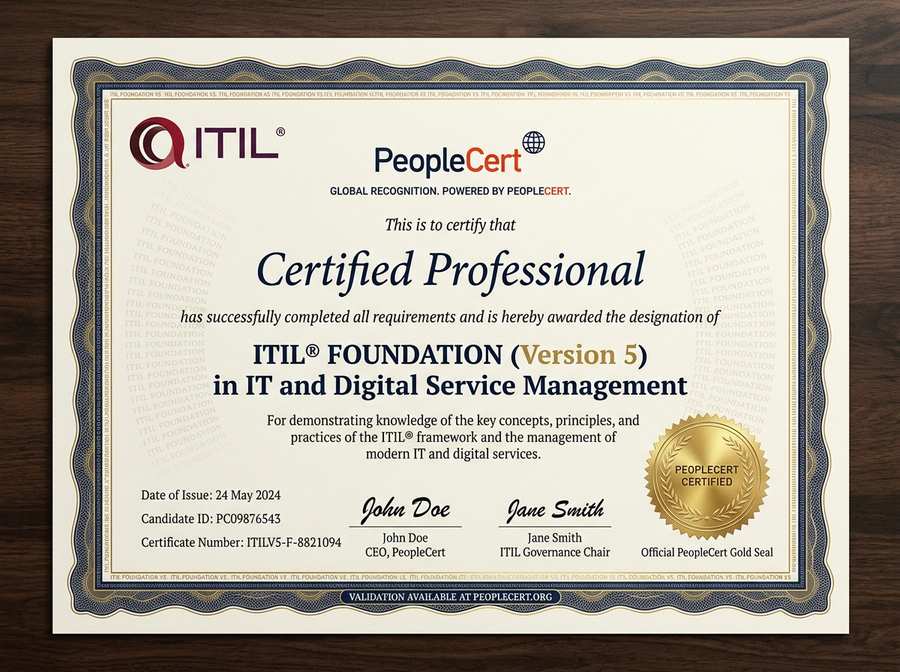
Earn Your ITIL® Foundation (Version 5) Credential

The ITIL® Foundation (Version 5) certificate awarded by PeopleCert validates your mastery of modern digital service management, the ITIL Value System, and AI-enabled operations. It is globally recognized across tech enterprises, banks, healthcare, and consultancy firms.

ITIL Foundation Version 5 Certificate Mockup

Global Professional Authority

Join the millions of certified professionals who lead service excellence and transformation in Fortune 500 enterprises.

AI & Digital Ready

Demonstrate knowledge of modern digital product lifecycles, cloud platforms, and AI governance in service management.

Career Advancement

Qualify for higher roles including IT Service Manager, Service Delivery Lead, Incident Manager, and Digital Product Owner.

Why Learn ITIL® Foundation with Aabiance?

01

Follow a clear learning sequence

Our 12-module plan starts with terminology and value co-creation, then builds logically toward the ITIL® Value System, lifecycle, practices, and exam readiness.

02

Connect concepts with workplace situations

Explore a Four Dimensions hands-on exercise and an incident value-stream walkthrough to understand how concepts operate in daily IT environments.

03

Build knowledge for work & assessment

Review the principles behind service management while practicing how to dissect, interpret, and conquer 40-question Foundation scenario questions.

04

Explore modern technology & AI relevance

Consider cloud services, automation, and AI-enabled operations alongside people, governance, and business outcome needs.

Discuss Your Learning Goals

ITIL® V5 Foundation Exam Format

Official examination specifications administered globally by PeopleCert.

Exam Detail Specification
Awarding Body PeopleCert
Question Type 40 Multiple-Choice Questions (MCQ)
Duration 60 Minutes (Extra time for non-native English speakers)
Pass Mark 65% — 26 correct answers out of 40
Exam Format Closed Book Examination
Delivery Mode Online Proctored (Take from home or office) or at an Authorized Test Centre
Languages English, Chinese, French, German, Italian, Japanese, Polish, Portuguese (Brazil), Spanish
Prerequisites None — Open to all candidates
Certificate Validity 3 years — Renew with 60 CPD points via PeopleCert Plus, or by passing another qualifying certification

How to Pass the Exam on Your First Attempt

  • Learn the definitions word-for-word: Many Foundation questions turn on exact terms, such as utility vs warranty or output vs outcome.
  • Read every option before answering: Scenario questions frequently include two plausible answers where one is more comprehensive.
  • Practice with timed mock exams: Complete at least 3 full-length timed mock exams and consistently hit 80%+ before scheduling your live exam.
  • Revise the seven guiding principles and practice purposes: These core concepts appear persistently across question categories.

How to Get ITIL® V5 Certified in 5 Steps

A streamlined pathway from enrollment to official global certification.

1

Enrol in Course

Enrol in the ITIL® Foundation (Version 5) course and choose live online or Chennai classroom format.

2

Attend Live Training

Complete the 2-day live training (16 hours) and participate in Four Dimensions and value-stream mapping exercises.

3

Practise Mock Tests

Practise with scenario-based mock exams with detailed explanations until you consistently exceed the 65% pass mark.

4

Book PeopleCert Exam

Our dedicated team helps you register and schedule your online proctored PeopleCert exam slot at your convenience.

5

Pass & Get Badge

Pass the 40-question exam (65%+) and receive your official PeopleCert certificate and verifiable digital badge.

What’s Included in Your ITIL® V5 Training?

Everything you need to master the concepts and ace the PeopleCert examination.

16 Hours Live Instructor Training

Live, interactive sessions conducted by an accredited ITIL® trainer with real enterprise consulting experience.

Official Course Materials

Comprehensive digital courseware, slides, and reference materials aligned with PeopleCert syllabus.

Exam Voucher Assistance

Guidance and provisioning for official PeopleCert exam vouchers, included or bundled with registration.

Scenario-Based Mock Exams

Full-length practice questions mirroring the 40-question, 60-minute real exam with detailed rationales.

Hands-On Exercise Workbook

Step-by-step workbook featuring Four Dimensions analysis, value stream mapping, and continual improvement worksheets.

Session Recordings & Free Repeat

Re-watch recorded classroom sessions and enjoy the flexibility of repeating a live batch within 6 months.

Post-Course Doubt Clearing

Direct mentor support via email and forum until you successfully pass your certification exam.

Aabiance Course Certificate

Official course-completion certificate confirming 16 PDU / Contact Hours in addition to your PeopleCert credential.

Flexible EMI Options

Pay conveniently in zero-cost or low-cost monthly installments. Speak to our advisors for installment plans.

Choose Your ITIL® V5 Training Mode

Select the learning format that best fits your schedule and learning style.

Live Online

Working professionals nationwide

Interactive weekend or weekday virtual batches with real-time Q&A, live exercises, and session recordings.

Classroom — Chennai

In-person classroom learners

Convenient Chennai training centre with high-touch face-to-face instruction, group discussions, and peer networking.

Corporate / In-House

Enterprise teams of 5+

Customized curriculum tailored to your enterprise tools, ITSM platforms, and organizational transformation goals.

1-to-1 Coaching

Busy executives & managers

Personalized one-on-one sessions scheduled at your own pace with customized deep-dives into your specific challenges.

ITIL® V5 Career Path & Certification Roadmap

ITIL® Foundation (Version 5) is the entry point to the whole ITIL® Version 5 scheme. After Foundation, you can progress to advanced modules — such as ITIL® Service (Version 5) — and build toward higher ITIL® designations as PeopleCert releases them.

ITIL® Foundation (Version 5) [You Are Here] ➔ Advanced Version 5 Modules (e.g., ITIL® Service) ➔ Higher ITIL® Master Designations

Roles that actively value ITIL® V5 certification:

Service Desk Analyst / Lead

Standardizes ticket triaging, incident routing, and user communication practices.

IT Operations / SRE Engineer

Aligns monitoring, incident prevention, and deployment pipelines with business SLA commitments.

Incident / Change Manager

Oversees change enablement, risk assessments, and outage post-mortems with structured governance.

IT / Service Delivery Manager

Maintains service level agreements, customer relationships, and continual service improvements.

Process Owner / ITSM Consultant

Designs and optimizes value streams across multiple teams, tools, and vendors.

Product Owner / Digital PM

Bridges the end-to-end lifecycle between product discovery, development, operations, and support.

Digital Transformation Lead

Guides cloud modernization, AI automation, and governance across enterprise operating models.

Join Our Live ITIL® Classes in Chennai & Online

Flexible schedules designed for working professionals. Small batches for personalized mentoring.

Mode Schedule Timing Status Action
Live Online Weekend Batch (Sat & Sun) 10:00 AM – 5:00 PM IST Upcoming Weekend 🔥 Fast Filling Enquire
Chennai Classroom Weekend Batch (Sat & Sun) 10:00 AM – 5:00 PM IST Next Weekend Seats Open Enquire
Live Online Weekend Batch (Sat & Sun) 10:00 AM – 5:00 PM IST Upcoming Batch Seats Open Enquire
Live Online Weekday Evening Batch 7:00 PM – 9:00 PM IST Upcoming Batch Seats Open Enquire

Success Stories from Aabiance Alumni

★★★★★

"The ITIL Foundation training with Aabiance was brilliantly structured. The Four Dimensions exercises and real-world value stream discussions made the framework instantly practical."

Suresh
Suresh Ramanathan Service Desk Lead, Chennai
★★★★★

"Cleared my PeopleCert exam on my first attempt with 92%! The scenario-based mock exams mirrored the real exam questions very closely."

Priya
Priya Sundaram IT Operations Consultant

Frequently Asked Questions

Clear answers to common questions about ITIL® Version 5 Foundation certification.

The ITIL® 5 Foundation exam is considered easy to moderate. Because it is an entry-level test, it focuses primarily on framework terminology, definitions, and concept recall rather than deeply technical, hands-on application.
No, you cannot skip it. The Foundation exam is a mandatory baseline entry point to establish a shared understanding of core ITIL® v5 terminology and value creation before you can move on to specialized advanced streams.
You must achieve a minimum score of 65% to pass. This means you must correctly answer at least 26 out of the 40 multiple-choice questions within the 60-minute time limit.
No, there are no mandatory prerequisites to sit for the ITIL® 5 Foundation exam. The path is open to any IT professional, student, or business stakeholder interested in learning IT Service Management (ITSM) directly from the ground up.
No, your ITIL® 4 certification remains valid. However, because ITIL® v5 introduces significant updates around AI governance, digital product lifecycles, and automation, upgrading through the ITIL® 5 Foundation Bridge module is highly recommended to stay competitive. Earning an ITIL® 5 credential also automatically extends the validity of your existing ITIL® 4 profile.
No, self-study is no longer an option for advanced streams. While you can review materials on your own for Foundation, PeopleCert mandates that you must complete official eLearning or training via an Accredited Training Organization (ATO) for all post-Foundation modules. Exam results will be withheld without proof of course completion.
No, it is a strictly closed-book examination. Candidates are not permitted to use any training manuals, notes, or digital resources during the live online-proctored test.
Most candidates require 2 to 4 weeks of dedicated preparation. Focusing heavily on the highest-weighted domains—such as the Service Value System (SVS) and The Four Dimensions—and hitting an 85%+ score on mock exams will ensure a comfortable pass.
The exam is structured across a few core pillars, but the heaviest focus is on Management Practices and the Service Value System (SVS). SVS components account for roughly 40% of the questions, while foundational knowledge of practices like Incident, Problem, and Change Management make up the majority of the remaining test points.
Yes, it is globally recognized and accepted across almost all major industries, including tech services, banking, telecom, healthcare, and government organizations worldwide.
whatsapp
Fast Filling Schedule
2-Day Weekend Limited Seats
Upcoming Batch
Sat–Sun  10AM – 5PM IST
Chennai Classroom & Online
Get Details Call +91 89255 99449
Talk to an Advisor

Talk to an ITIL Advisor