
Introduction
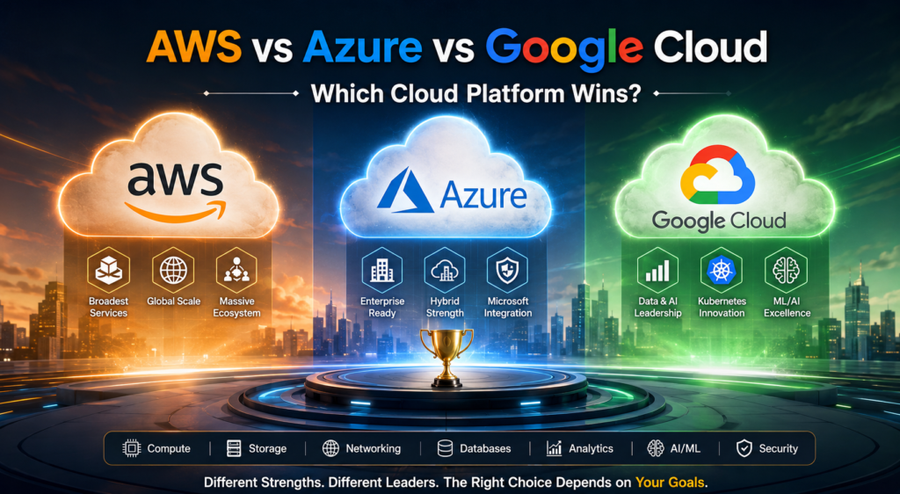
There isn’t a clean, universal winner between AWS, Azure, and Google Cloud, and anyone who tells you otherwise is probably selling you a course. The honest answer is that each platform wins in a different context: AWS for sheer breadth and job availability, Azure for enterprises already living inside Microsoft’s ecosystem, and Google Cloud for data-heavy and AI-first workloads.
The Market Reality Nobody Skips Past
Start with the numbers, because they shape almost every other decision that follows. AWS has held the largest share of the global cloud infrastructure market for well over a decade, and that lead, while narrowing slightly year over year, still translates directly into job postings, third-party tool integrations, and community support. Azure sits comfortably in second place, propped up heavily by enterprises already running Windows Server, Active Directory, and Office 365; migrating those workloads to Azure is often the path of least resistance for large corporations. Google Cloud trails both in overall market share but punches well above its weight in data analytics, machine learning, and Kubernetes-native workloads, largely because Google essentially invented Kubernetes and still runs some of the most sophisticated internal infrastructure in the industry.
None of this means smaller players are irrelevant; it means your starting decision should be shaped by where the jobs and workloads actually are, not by brand loyalty or a single glowing blog post.
Where Each Platform Genuinely Pulls Ahead
AWS’s biggest strength isn’t any single service; it’s sheer catalog depth. Whatever obscure infrastructure problem you’re solving, there’s probably already a managed AWS service built for it, from IoT device management to satellite ground station connectivity. That breadth comes with a real cost: the learning curve is steeper, and the console can feel overwhelming to newcomers navigating hundreds of services.
Azure’s strength shows up most clearly in hybrid environments. A manufacturing company running legacy on-premises systems alongside modern cloud workloads will typically find Azure’s hybrid tooling, particularly Azure Arc, far more mature than equivalent offerings elsewhere. Enterprises with heavy Microsoft licensing agreements also benefit from bundled pricing that makes Azure the financially obvious choice, regardless of technical preference.
Google Cloud’s advantage concentrates around data and AI. BigQuery remains one of the most genuinely loved data warehousing tools among data engineers, and Google’s machine learning tooling built on the same infrastructure powering Search and YouTube recommendations often outperforms competitors for teams doing serious ML work. A startup building a recommendation engine or a data-heavy analytics product frequently finds Google Cloud’s tooling saves real engineering time compared to stitching together equivalent services elsewhere.
A Direct Side-by-Side Comparison
| Factor | AWS | Azure | Google Cloud |
| Market Share | Largest globally | Second largest | Third largest |
| Best Fit | General-purpose, broadest use cases | Enterprises using Microsoft stack | Data analytics, AI/ML workloads |
| Learning Curve | Steep, but most resources available | Moderate, especially for Windows admins | Moderate, strong for data roles |
| Job Market Size | Largest number of open roles | Strong, especially in enterprise IT | Growing fastest in data/AI roles |
| Pricing Flexibility | Extensive but complex pricing tiers | Often bundled with existing licenses | Competitive, simpler discount structure |
Different Strengths, Different Leaders. The Right Choice Depends On Yours Goals
Career Decisions: Betting on the Right Platform
If you’re a working professional deciding where to invest your learning hours, the safest statistical bet remains AWS, purely because of job volume. Recruiters searching for cloud engineers, DevOps professionals, or architects overwhelmingly filter by AWS experience first, simply because more companies run on it. Earning an AWS Solutions Architect certification, for instance, signals to hiring managers that you can reason through the exact kind of architectural trade-offs that dominate real cloud jobs: cost versus performance, security versus convenience, regardless of which specific services a future employer happens to use.
That said, “safest” doesn’t mean “only sensible option.” If you’re already working at a company deeply embedded in Microsoft tools, or you’re drawn specifically to data science and machine learning roles, specializing in Azure or Google Cloud respectively, can be the smarter individual bet, even if it’s the smaller market overall. Chasing market share blindly, without considering your existing skill set or target industry, is how people end up with a certification that doesn’t actually match the jobs they’re applying for.
Learning Pathways and Where Location Comes In
Certifications only take you so far without hands-on practice, and this is where structured training genuinely earns its cost. In fast-growing tech hubs, AWS courses in Chennai have expanded noticeably over the past two years, reflecting the city’s rising concentration of product companies, GCCs, and cloud-first startups. Good programs combine console-based labs with real architecture exercises deploying a multi-tier application, configuring IAM policies, setting up auto-scaling rather than simply walking through slide decks and definitions.
If you’re comparing training providers, whether local or online, ask a simple question before enrolling: does the course let you actually build something end-to-end inside a real AWS sandbox, or does it just prepare you to answer multiple-choice questions? The former produces engineers who can function on day one of a job; the latter mostly produces people who pass exams and then freeze during their first production incident.
Multi-Cloud Reality: Why Many Companies Don’t Actually Pick Just One
Here’s something the “AWS vs Azure vs Google Cloud” framing often glosses over: a growing number of mid-to-large companies run genuine multi-cloud environments, not out of indecision but out of deliberate risk management and negotiating leverage. A retail company might run its core e-commerce platform on AWS for its mature service catalog, while routing its data warehouse and analytics pipeline through Google Cloud for BigQuery’s performance advantages. A financial services firm might run customer-facing applications on AWS while keeping internal enterprise tools on Azure because that’s where its existing Active Directory infrastructure already lives.
This matters for your career planning too. Increasingly, senior cloud roles, especially architect-level positions, expect at least conversational fluency across more than one provider, even if your primary certification and daily work center on one platform. Understanding how these three ecosystems differ conceptually, not just service-by-service, makes you noticeably more valuable in interviews at companies running hybrid or multi-cloud setups.
What the Certification Actually Buys You Beyond the Badge
It’s worth being honest about what these credentials do and don’t deliver. The real AWS certification benefits aren’t limited to passing an exam; they include a structured way of thinking about cost governance, security boundaries, and system design that transfers even when you eventually touch Azure or Google Cloud environments later in your career. Recruiters use certifications as a screening signal, yes, but the deeper value shows up in interviews, where certified candidates typically articulate architectural reasoning more clearly than those who’ve only worked hands-on without formal study. The badge opens the door; the underlying reasoning skill is what keeps you in the room.
Making the Actual Decision
If you’ve read this far hoping for a single definitive verdict, here’s the closest thing to one: for most learners and most companies starting from zero, AWS remains the statistically safer starting point because of its job market size and service breadth. Azure becomes the smarter choice the moment Microsoft infrastructure is already deeply embedded in your organization. Google Cloud becomes genuinely superior the moment your core problem is data at scale or machine learning rather than general-purpose infrastructure. Very few situations demand an absolute, permanent choice; most careers and most companies eventually touch more than one platform, and understanding all three conceptually, even while specializing in one, is what actually future-proofs you.
Bringing It All Together
The “AWS vs Azure vs Google Cloud” debate isn’t really a competition with a final scoreboard; it’s a matching exercise between your goals and each platform’s genuine strengths. Start with where the jobs are concentrated, factor in your existing skills and industry, and don’t be afraid to specialize even in a smaller ecosystem if it fits your actual work better. Whichever platform you choose first, pair the certification with real hands-on practice, because that combination, not the badge alone, is what actually convinces employers and clients that you know what you’re doing.
FAQ
- Which cloud platform is best for beginners, AWS, Azure, or Google Cloud? AWS is generally the best starting point for beginners because of its larger job market, extensive documentation, and broader community support, though Azure suits those already familiar with Microsoft tools.
- Is AWS still the market leader in cloud computing in 2026? Yes, AWS continues to hold the largest global market share, though Azure and Google Cloud have both grown steadily, narrowing the gap in specific industry segments.
- Which cloud platform pays the highest salaries for certified professionals? AWS-certified professionals often see the highest overall salary numbers due to demand volume, but Azure and Google Cloud specialists in high-demand niches like AI and hybrid cloud can earn comparably strong packages.
- Should I learn more than one cloud platform? Learning a second platform becomes valuable as you advance toward senior or architect-level roles, since many companies now run multi-cloud environments requiring cross-platform fluency.
- Is Google Cloud better than AWS for machine learning projects? Google Cloud’s machine learning tooling, particularly Vertex AI and BigQuery, is widely regarded as a strong option for data-heavy and AI-focused workloads, often outperforming general-purpose alternatives for those specific use cases.
- Why do enterprises choose Azure over AWS? Enterprises already invested in Microsoft products like Windows Server and Active Directory often choose Azure for smoother hybrid integration and bundled licensing costs.
- Are AWS certifications still valuable if I eventually work with multiple clouds? Yes, the architectural reasoning and cost-governance thinking taught through AWS certification generally transfer well to other cloud platforms, even if the specific services differ.
- How do I decide which cloud platform to specialize in for my career? Base your decision on your target industry, existing technical background, and local job market demand rather than market share alone, since each platform has genuine strengths suited to different roles.
Written by
Venkat Raman
Expert instructor and certified professional with extensive experience training working professionals for global certifications including PMP, AWS, CSM, and PSM.