Introduction
The demand for Scrum professionals continues to grow as organizations embrace Agile methodologies to deliver projects faster, improve collaboration, and adapt quickly to changing customer needs. While all three certifications validate Scrum knowledge, they differ in training approach, exam structure, recognition, and practical application. This guide compares every important aspect of these certifications so you can confidently select the best agile scrum certification for your career in 2026.
Why Scrum Certifications Matter More Than Ever
Modern organizations no longer view Scrum as just a software development framework. Today, Agile teams exist across banking, healthcare, manufacturing, retail, cloud computing, artificial intelligence, and even government sectors. Companies seek professionals who understand Sprint Planning, Product Backlogs, Daily Scrum meetings, stakeholder collaboration, and continuous improvement.
A recognized Scrum certification demonstrates that you understand Agile principles and can contribute effectively to cross-functional teams. Whether you’re a fresher or an experienced project manager, becoming an agile scrum master can significantly improve your career opportunities and earning potential.
Understanding the Three Most Popular Scrum Certifications
Although they all focus on Scrum, each certification serves a different purpose.
Certified ScrumMaster (CSM)
The certified scrum master certification offered by Scrum Alliance is one of the world’s most recognized entry-level Scrum certifications.
Candidates must attend official instructor-led training before taking the certification exam. The learning experience emphasizes collaboration, practical exercises, and real-world Scrum implementation.
CSM is particularly suitable for:
- Beginners entering Agile
- Project coordinators
- Team leaders
- Software professionals
- Product owners
- Business analysts
Because classroom learning is mandatory, many professionals find CSM easier to understand than purely self-study certifications.
Professional Scrum Master (PSM)
Professional Scrum Master certification, provided by Scrum.org, focuses heavily on deep Scrum knowledge and framework understanding. Unlike CSM, attending training is optional. Candidates can prepare independently before taking the assessment.
The exam is generally considered more challenging because it tests practical scenarios rather than simple theoretical knowledge. PSM is ideal for professionals who already possess Agile exposure and want to demonstrate strong conceptual expertise.
Agile Scrum Master (ASM)
The agile scrum master certification focuses on applying Agile and Scrum principles in real business environments. Many training providers combine Agile fundamentals, Scrum practices, collaboration techniques, servant leadership, Kanban basics, stakeholder management, and project simulations into one practical learning program.
This certification is often chosen by professionals seeking hands-on project experience rather than only theoretical knowledge.
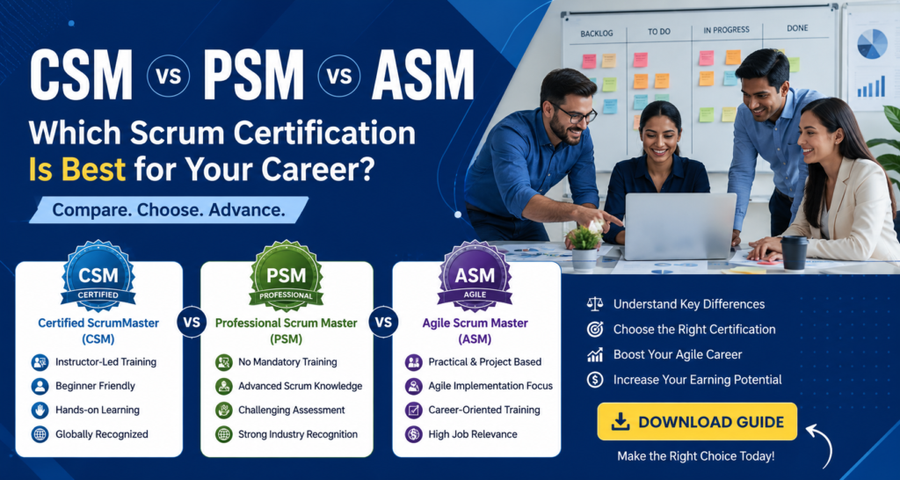
Difference Between CSM, PSM, and ASM
| Feature | CSM | PSM | ASM |
| Training Requirement | Mandatory | Optional | Usually Included |
| Exam Difficulty | Moderate | High | Moderate |
| Learning Style | Instructor-led | Self-study or training | Practical & project-oriented |
| Focus | Scrum fundamentals | Advanced Scrum understanding | Agile implementation |
| Best For | Beginners | Experienced professionals | Career changers & working professionals |
| Industry Recognition | Excellent | Excellent | Growing rapidly |
| Practical Exercises | Extensive | Limited unless trained | High |
| Certification Renewal | Required | No renewal (for most levels) | Depends on provider |
CSM vs PSM vs ASM: Which Scrum Certification Is Best?
Choosing the Right Certification Based on Your Career Goals
Instead of asking which certification is universally better, ask which one aligns with your professional objectives.
If You’re New to Agile
If you’ve never worked in Agile projects, the certified scrum master certification offers structured learning with experienced instructors.
You’ll gain:
- Scrum fundamentals
- Team collaboration skills
- Sprint planning experience
- Real-life case studies
- Interactive workshops
This learning format helps beginners build confidence quickly.
If You Already Work in Agile Teams
Professionals with Scrum experience often prefer PSM because it validates deeper Scrum knowledge without requiring mandatory classroom attendance. PSM demonstrates strong conceptual understanding, making it valuable for experienced Scrum practitioners.
If You Want Practical Industry Skills
If your objective is immediate workplace readiness, an agile scrum master training program emphasizing simulations, case studies, AI-powered Agile tools, and collaborative exercises may provide greater practical value.
Employers increasingly appreciate professionals who can immediately contribute to Agile teams rather than only understand theory.
Industry Trends That Influence Certification Value in 2026
The Agile landscape continues evolving rapidly.
Several emerging trends are shaping certification demand:
AI-Assisted Sprint Planning
Teams now use AI tools for backlog refinement, effort estimation, documentation, and sprint reporting.
Hybrid Agile Models
Organizations combine Scrum with Kanban, DevOps, Lean, and SAFe methodologies.
Cloud-Native Development
Cloud engineering teams increasingly require Scrum knowledge alongside AWS, Azure, and DevOps expertise.
Enterprise Agile Transformation
Large organizations seek Scrum Masters capable of coaching multiple teams rather than facilitating individual projects.
Because of these changes, employers increasingly value professionals who combine certification with practical implementation experience.
Real Career Scenarios: Which Certification Fits Best?
Imagine three professionals starting different career journeys.
Scenario 1
A recent engineering graduate wants to enter software development.
The certified scrum master certification provides structured learning, helping them understand Agile workflows before joining a Scrum team.
Scenario 2
A project manager with five years of experience already leads Agile meetings.
PSM becomes an excellent option because it validates advanced Scrum knowledge and strengthens professional credibility.
Scenario 3
A cloud engineer moving into leadership wants practical Scrum implementation skills.
An agile scrum master certification program with hands-on projects and real Sprint simulations can prepare them for cross-functional team leadership.
Each professional reaches the same destination through a different learning path.
Conclusion
CSM, PSM, and ASM all provide valuable pathways into Agile careers, but they serve different professional needs. If you’re looking for structured learning and global recognition, the certified scrum master certification remains an excellent starting point. If you already have Agile experience and want to demonstrate your expertise, PSM offers deeper assessment. Ultimately, the best Agile Scrum certification is the one that aligns with your career goals, learning style, and industry requirements. Combine certification with real project experience, continuous learning, and strong communication skills to maximize your opportunities in today’s Agile-driven workplace.
FAQ
1. Which is the best agile scrum certification for beginners?
CSM is generally considered the best starting point because it includes instructor-led training and practical learning before the examination.
- Is PSM harder than the certified scrum master certification?
Yes. Most professionals consider PSM more challenging because it focuses on applying Scrum concepts in practical scenarios rather than testing basic theoretical knowledge.
- Can an agile scrum master work outside software development?
Absolutely. Scrum is now used in finance, healthcare, marketing, education, manufacturing, consulting, and product development.
- Which certification is most recognized globally?
Both the certified scrum master certification and PSM have strong international recognition among employers.
- Do Scrum certifications increase salary?
Yes. Certified Scrum professionals often qualify for higher-paying Agile, project management, product management, and leadership roles.
- Should experienced professionals choose PSM instead of CSM?
Professionals already working in Scrum environments often choose PSM because it validates deeper Scrum knowledge without requiring mandatory training.
- Is practical experience more important than certification?
Yes. Certification helps you secure interviews, while practical Scrum experience helps you succeed in the role and progress your career.
- Can I earn multiple Scrum certifications?
Absolutely. Many professionals begin with the certified scrum master certification, later pursue PSM, and continue building expertise through advanced Agile certifications as their careers grow.
Written by
Venkat Raman
Expert instructor and certified professional with extensive experience training working professionals for global certifications including PMP, AWS, CSM, and PSM.