Introduction
A brilliant architecture with a single misconfigured S3 bucket is still a breach waiting to happen. That’s the uncomfortable truth every AWS architect eventually learns — usually the hard way, after a security review flags something that should have been caught in design, not in production. Security in AWS isn’t a bolt-on skill you pick up after mastering compute and storage; it’s a thread that runs through every design decision from day one. Here are the ten skills that separate architects who merely pass a security audit from those who actually prevent the incident in the first place.
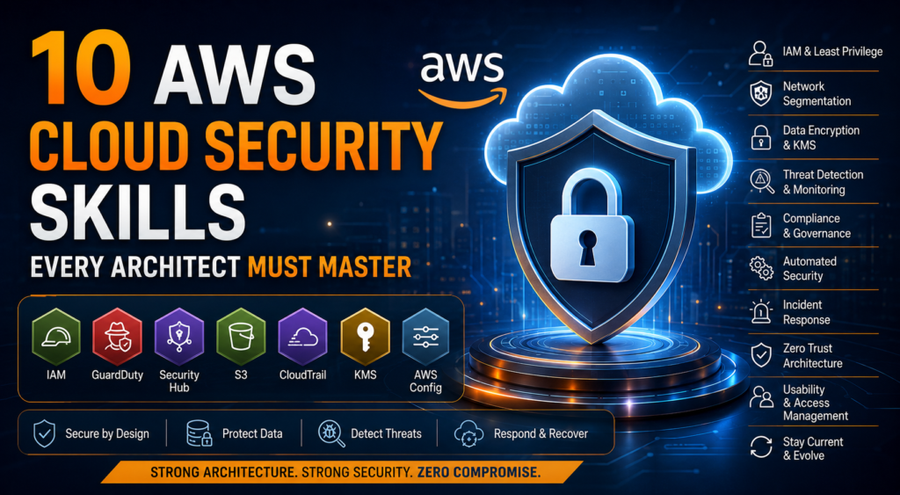
1. Reasoning Through Identity and Access Management, Not Just Configuring It
Most engineers know how to create an IAM role. Fewer can explain why a particular permission boundary exists or predict how a policy will behave when combined with three other overlapping policies attached to the same resource. Real IAM mastery means thinking in terms of least privilege from the start — granting exactly what a service or user needs, nothing more — and understanding how policy evaluation logic actually resolves conflicts between explicit denies, allows, and boundaries. A common failure pattern shows up when teams grant broad administrative access “temporarily” during a deployment crunch and simply forget to revoke it. Architects who’ve internalized this skill build access reviews into the deployment process itself, rather than treating them as an annual compliance checkbox.
2. Designing Network Segmentation That Actually Contains a Breach
VPC design looks simple on a whiteboard — public subnet here, private subnet there — until you’re accounting for how a compromised application server in one subnet shouldn’t have a clear path to your database tier in another. Skilled architects design security groups and network ACLs as layered defenses, not single checkpoints, and they use VPC flow logs actively rather than just enabling them and forgetting they exist. A useful mental exercise: if an attacker compromised your single most exposed service today, how far could they actually move laterally before hitting a wall? If the honest answer is “pretty far,” your segmentation needs work regardless of how clean your architecture diagram looks.
3. Encrypting Data With Intention, Not Just Enabling a Checkbox
Encryption at rest and in transit has become such a standard checkbox in AWS console setups that it’s easy to enable it without actually understanding key management. A genuinely skilled architect knows the difference between AWS-managed keys and customer-managed keys in KMS, understands when key rotation policies matter for compliance requirements, and can explain exactly who could access encrypted data if IAM permissions were misconfigured. This distinction matters enormously in regulated industries — a healthcare application handling patient records under compliance frameworks needs far more deliberate key management than an internal analytics dashboard.
4. Building Detection Capability Before You Need It
Prevention matters, but architects who’ve been through a real incident know detection is what actually saves you when prevention inevitably fails somewhere. This means genuine fluency with GuardDuty for threat detection, Security Hub for centralized findings, and CloudTrail for the audit trail that answers “what actually happened” after something goes wrong. The skill isn’t just knowing these services exist — it’s configuring them to surface signal instead of noise. A team that ignores GuardDuty findings because they’re drowning in low-priority alerts has effectively built a detection system nobody actually watches, which is barely better than having none at all.
5. Understanding Compliance Frameworks Well Enough to Design Around Them
Architects working with regulated industries — finance, healthcare, government contracting — need more than a passing familiarity with frameworks like HIPAA, PCI-DSS, or SOC 2. They need to understand which specific AWS services and configurations satisfy which specific controls, because compliance auditors ask pointed questions, not vague ones. An architect who can map “this control requires encrypted data in transit” directly to “here’s how our API Gateway and ALB configuration satisfies that” moves through audits far faster than one who has to research the answer live during the review.
Strong Architecture, Strong Security, Zero Compromise
6. Automating Security Instead of Relying on Manual Reviews
Manual security reviews don’t scale, and the architects who understand this build security directly into their infrastructure-as-code templates using tools like AWS Config rules and Service Control Policies at the organization level. This means a new S3 bucket that violates encryption policy gets flagged or blocked automatically at creation time, rather than discovered three months later during an audit. This is genuinely one of the highest-leverage skills on this list, because it shifts security from a reactive, human-dependent process to a proactive, automated guardrail that scales with your infrastructure rather than against it.
7. Practicing Incident Response Before an Actual Incident
Knowing the theory of incident response and actually being useful during a live security event are two very different skills. Architects who’ve built genuine muscle memory here have participated in — or at minimum designed — tabletop exercises simulating scenarios like a leaked access key or a compromised EC2 instance, and they know exactly which AWS services to pull logs from within the first ten minutes of a real incident. The difference between a contained incident and a genuine crisis often comes down to how quickly the right person can access the right logs and isolate the right resource, and that speed only comes from practice, not documentation you’ve never actually used under pressure.
8. Applying Zero Trust Principles Within a Single Cloud Account
Zero trust gets thrown around as a buzzword, but the practical skill underneath it is straightforward: never assume internal traffic is automatically safe just because it’s inside your VPC. Architects applying this properly implement service-to-service authentication even between internal microservices, use short-lived credentials instead of long-lived access keys wherever possible, and treat every request — internal or external — as something that needs verification. A financial services company handling transaction data, for example, might require mutual TLS authentication between internal services precisely because “it’s inside our network” stopped being a sufficient security guarantee years ago.
9. Balancing Security Rigor With Genuine Usability
This skill gets underrated constantly, but experienced architects know that security controls developers actively work around are worse than no controls at all. If your access request process takes three days and five approvals for a routine task, engineers will find workarounds that bypass your carefully designed controls entirely — shared credentials, overly broad temporary roles, whatever gets the job done fastest. The real skill is designing security processes people actually follow because they’re reasonably fast, not just theoretically airtight on paper. This is where technical security knowledge intersects with genuine organizational judgment.
10. Staying Current as AWS’s Security Tooling Evolves
AWS ships new security features and services at a pace that makes static knowledge genuinely dangerous within a couple of years.This is less a discrete skill and more a discipline — treating security knowledge as something requiring ongoing maintenance, not a certificate earned once and shelved.
Where Certification Fits Into Building These Skills
Structured certification study is genuinely one of the more efficient paths through this list, because exam blueprints for advanced AWS credentials are deliberately built around these exact competencies rather than trivia. Someone pursuing an AWS Solutions Architect certification at the Professional level will encounter scenario-based questions covering IAM edge cases, encryption trade-offs, and network segmentation design almost identically to how they’d show up in a real production environment.
Structured Learning Versus Self-Guided Practice
| Approach | Strengths | Limitations |
| Certification-guided study | Structured coverage, exam-validated benchmarks | Can feel theoretical without applied labs |
| Hands-on sandbox practice | Builds genuine muscle memory, mirrors real incidents | Easy to develop gaps in less-familiar areas |
| Instructor-led training programs | Combines structure with guided lab practice | Cost and time commitment higher than self-study |
Conclusion
Security isn’t a separate specialty bolted onto architecture work anymore — it’s the lens every design decision should pass through before it ships. The ten skills above aren’t independent checkboxes; they reinforce each other, from IAM discipline feeding into better automated guardrails, to detection capability feeding into faster incident response. Build these skills deliberately, pair theoretical study with genuine hands-on practice, and you’ll design systems that don’t just pass an audit but actually hold up under real pressure.
FAQ
- What is the most important AWS security skill for architects to learn first? Identity and Access Management fundamentals should come first, since nearly every other security control depends on properly scoped permissions and least-privilege design.
- Do I need the AWS Security Specialty certification to become a strong security-focused architect? It’s not strictly required, but it provides structured, scenario-based coverage of advanced security concepts that significantly accelerates skill development compared to unguided learning.
- How important is automation in AWS cloud security? Automation is essential at scale, since manual security reviews can’t keep pace with growing infrastructure, making tools like AWS Config and Service Control Policies critical for consistent enforcement.
- What’s the difference between detection and prevention in AWS security? Prevention focuses on stopping security issues before they occur, such as through IAM policies and encryption, while detection focuses on identifying and responding to incidents that bypass preventive controls.
- Can zero trust principles be applied within a single AWS account? Yes, zero trust applies internally as well, meaning even traffic between services inside the same VPC should be authenticated and verified rather than automatically trusted.
- How do compliance frameworks like HIPAA or PCI-DSS affect AWS architecture decisions? They require architects to map specific AWS configurations directly to specific compliance controls, influencing decisions around encryption, logging, and access management from the design stage onward.
- Are local training programs effective for learning AWS security skills? Yes, especially programs offering hands-on labs alongside theoretical instruction, since practical exposure to misconfigurations and simulated incidents builds skills that reading alone typically doesn’t.
- How often should AWS security knowledge be updated? Given how frequently AWS updates its security tooling, architects should treat security knowledge as an ongoing discipline, revisiting key services and best practices at least every year.
Written by
Venkat Raman
Expert instructor and certified professional with extensive experience training working professionals for global certifications including PMP, AWS, CSM, and PSM.