Introduction
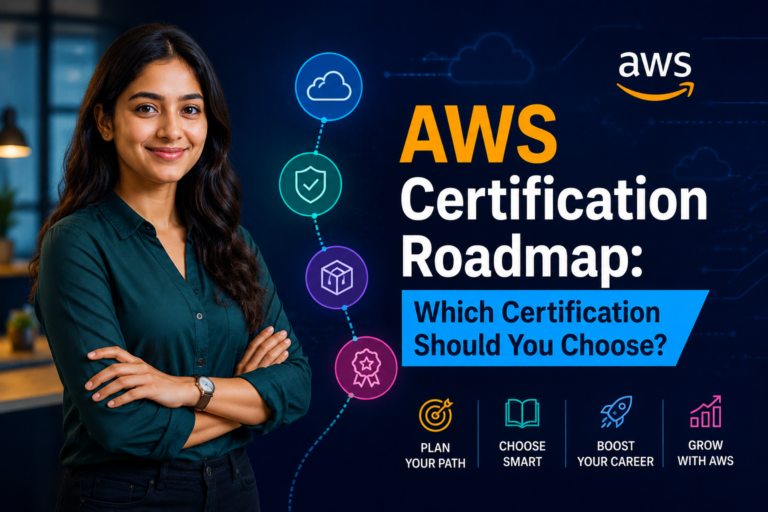
If you’ve spent even ten minutes browsing AWS’s certification page, you already know the problem: twelve different badges are staring back at you, each promising to unlock a “high-paying cloud career.” So which one actually deserves your time, your money, and your next three months of weekend studying? The short answer: it depends on where you stand today and where you want to land. This guide walks through the entire ladder, from someone who has never opened the AWS console to someone eyeing a six-figure architect role, so you can pick a path instead of guessing.
Why the AWS Certification Ladder Exists in the First Place
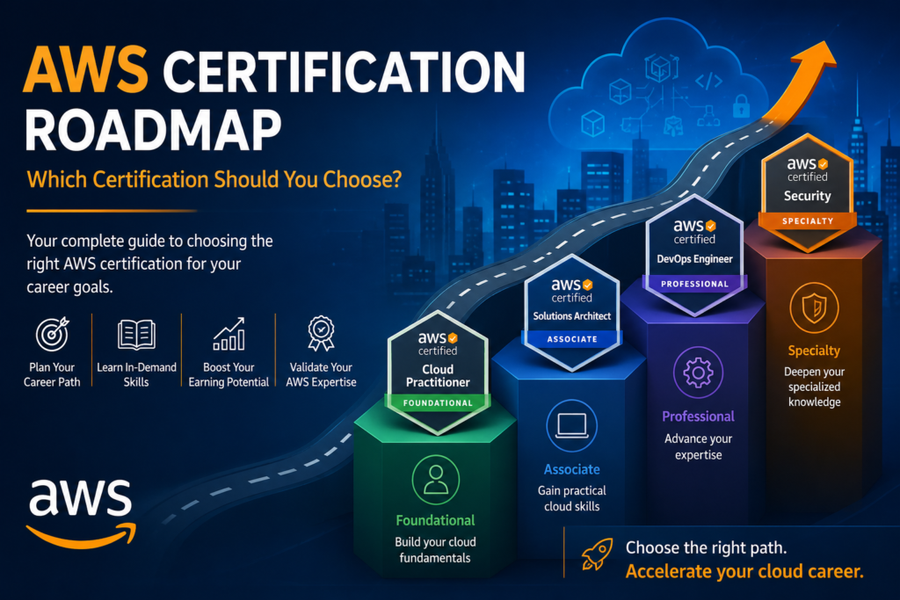
Amazon didn’t design this ladder to sell exam vouchers; it built it because cloud roles genuinely differ in depth. A support engineer troubleshooting an EC2 instance needs different knowledge than someone designing a multi-region disaster recovery architecture for a bank. That’s why AWS splits its badges into four tiers: Foundational, Associate, Professional, and Specialty. Each tier assumes the one before it, which is exactly why jumping straight to a Professional-level exam without any hands-on experience usually ends in a failed attempt and a wasted registration fee.
Understanding this structure matters more than memorizing exam codes. Once you see the ladder as a career progression rather than a checklist, the decision of “which certification first” becomes much easier to answer honestly.
Starting Point: Do You Need the Foundational Badge At All?
The AWS Certified Cloud Practitioner is often dismissed as “too basic,” and for some people, that’s a fair criticism. If you’re already a working developer or sysadmin who’s touched AWS services for a year or more, you can likely skip straight to an Associate-level exam. But if you’re coming from a non-technical background, switching careers into IT, or you’re a student trying to build a resume, this foundational certificate is worth the two or three weeks it takes to prepare. It covers billing, shared responsibility, core services, and basic security concepts the vocabulary you’ll need before anything else makes sense.
Your complete guide to choosing the right AWS certification for your career goals
The Associate Tier: Where Most Careers Actually Begin
This is where the real decision-making happens, and it usually comes down to three options: Solutions Architect Associate, Developer Associate, or SysOps Administrator Associate.
The AWS Solutions Architect certification is by far the most popular starting point, and there’s a good reason for that. It teaches you how services fit together: networking, storage, compute, and security rather than how to write code against a single service. If your goal is consulting, pre-sales, cloud engineering, or eventually becoming a cloud architect, this is the natural entry point. Recruiters recognize it instantly, and it pairs well with almost any job title in the cloud space.
Developer Associate, on the other hand, suits people who already write application code and want to deploy it using AWS-native tools like Lambda, DynamoDB, and API Gateway. SysOps Administrator Associate fits operations-focused professionals who spend their day monitoring, scaling, and troubleshooting live environments rather than designing them from scratch.
Here’s a quick comparison to make the choice concrete:
| Certification | Best For | Core Focus | Typical Next Step |
| Solutions Architect Associate | Architects, consultants, generalists | System design, service integration | Solutions Architect Professional |
| Developer Associate | App developers, backend engineers | Serverless, APIs, code deployment | DevOps Engineer Professional |
| SysOps Administrator Associate | IT ops, support engineers | Monitoring, automation, troubleshooting | DevOps Engineer Professional |
Your complete guide to choosing the right AWS certification for your career goals
Where Location and Training Quality Actually Matter
Certifications test knowledge, but hands-on labs build the confidence to use that knowledge under pressure, and that’s where structured training earns its cost. For learners in South India, AWS courses in Chennai have grown substantially over the last two years, driven by the city’s expanding IT and product engineering sector. Good programs in the city typically combine instructor-led sessions with sandbox environments where you can actually break things, terminate the wrong instance, misconfigure a security group, and watch a Lambda function time out without it costing you a production outage.
If you’re evaluating options locally, look past the marketing brochures and ask three practical questions: does the course include real AWS console access (not just slides), does it map directly to the current exam blueprint, and does the trainer have production experience beyond just teaching certifications. A course that answers “yes” to all three is worth far more than one offering a longer syllabus with shallower content.
Professional and Specialty: The Tier That Actually Moves Salaries
Once you’ve cleared an Associate exam and worked with AWS for a year or so, the Professional tier becomes realistic. Solutions Architect Professional and DevOps Engineer Professional are widely regarded as the two toughest exams in the entire catalog, not because the questions are tricky for the sake of it, but because they test judgment across multiple overlapping constraints: cost, security, availability, and performance, often within the same scenario-based question.
Specialty certifications: Security, Machine Learning, Data Analytics, Networking, and Database exist for people who want to go deep rather than broad. You typically don’t need one unless your job specifically demands that expertise. A cloud security engineer benefits enormously from the Security Specialty; a generalist architect usually doesn’t need it at all.
What the Badge Actually Buys You
It’s fair to ask whether any of this effort translates into something measurable, and the honest answer is yes, with caveats. The most tangible AWS certification benefits show up in three places: resume filtering (many recruiters use certifications as an automated screening criterion before a human even reads your experience), salary negotiation leverage (certified professionals consistently report higher starting offers in industry salary surveys), and internal mobility (companies running AWS often prioritize certified employees for cloud migration projects). What certifications don’t buy you is a shortcut around actual hands-on skill; interviewers at good companies will still ask you to whiteboard an architecture or debug a broken deployment, badge or no badge.
Building Your Own 12-Month Roadmap
Rather than following someone else’s exact sequence, sketch out your own timeline based on your current job and goal role. A realistic pattern for a career switcher looks like: Cloud Practitioner in month one, Solutions Architect Associate by month four, six months of applied project work or a junior cloud role, then Solutions Architect Professional or DevOps Engineer Professional by month twelve. For someone already working as a developer, you can likely skip the foundational exam and go straight to Developer Associate, then Professional-level within eight to nine months.
The exact months matter less than the sequencing logic: foundational concepts, then one Associate specialization aligned to your actual job function, then real-world exposure, then Professional depth.
Final Thoughts
There’s no single “best” AWS certification; there’s only the certification that matches where you are and where you’re headed. Start honestly: if you’re new to cloud, begin with the fundamentals; if you already know your target role, jump straight to the Associate exam that mirrors it. Treat the badge as evidence of a learning journey, not the destination itself, and pair every exam with genuine console time. That combination the right certification path plus real practice is what actually moves careers forward.
.
FAQ
- Which AWS certification should a complete beginner start with? Most beginners should start with AWS Certified Cloud Practitioner, since it builds the vocabulary and foundational concepts needed for every higher-level exam.
- Is the AWS Solutions Architect Associate exam hard for beginners? It’s manageable with two to three months of consistent study and hands-on labs, though it does assume some basic cloud familiarity from the foundational level.
- How long does it take to prepare for AWS certification exams overall? Foundational exams typically take three to four weeks, Associate-level exams take two to three months, and Professional-level exams often require four to six months of preparation alongside real project experience.
- Are AWS certifications worth it in 2026? Yes, cloud adoption continues to rise across industries, and certified professionals still see measurable advantages in hiring screens and salary negotiations, though practical skills remain equally important.
- What is the difference between AWS Associate and Professional certifications? Associate exams test individual service knowledge and basic architecture decisions, while Professional exams test complex, multi-service scenarios involving cost, security, and performance trade-offs simultaneously.
- Do I need a Specialty certification if I already have a Professional one? Not necessarily. Specialty certifications are only useful if your role specifically requires deep expertise in areas like security, networking, or machine learning.
- Are local AWS training programs better than online self-study? It depends on learning style; structured local programs with hands-on labs, especially in growing tech hubs, can accelerate understanding, but disciplined self-study with practice labs works just as well for motivated learners.
- Which AWS certification has the best salary impact? Professional-level certifications, particularly Solutions Architect Professional and DevOps Engineer Professional, tend to show the strongest salary correlation according to industry compensation surveys.
Written by
Venkat Raman
Expert instructor and certified professional with extensive experience training working professionals for global certifications including PMP, AWS, CSM, and PSM.