Introduction
Picture two engineers with the same five years of IT experience. One spends their day writing code inside a single application. The other decides which services talk to which, how traffic flows between regions, and what happens if a data center goes dark at 3 a.m. That second person is usually the one with the title “Solutions Architect,” and it’s one of the few cloud roles where technical depth and business judgment matter equally. If you’re weighing whether this path is worth the pivot, here’s what the salary numbers, skill requirements, and day-to-day work look like in 2026.
Why This Role Sits at the Center of Cloud Hiring
Companies don’t hire solutions architects to write more code; they hire them to prevent expensive mistakes. A poorly designed architecture can quietly rack up thousands of dollars in unnecessary compute costs, or worse, collapse under load during a product launch. That’s why this role reports directly to engineering leadership in most mid-to-large organizations, and why it commands a premium over adjacent titles like backend developer or systems administrator. The architect is the person accountable when things go right and, more importantly, when they go wrong.
This accountability is exactly why the role attracts people from varied backgrounds former developers, ex-network engineers, even database administrators all converging on architecture because it rewards breadth over narrow specialization.
What the Paycheck Actually Looks Like
Compensation for this role varies more than most job seekers expect, and location, certification, and years of hands-on architecture experience all pull the number in different directions. Entry-level architects with one certification and limited production experience typically land in the lower-middle band of cloud salaries. Mid-career architects with three to five years of designing live systems and a Professional-level badge see a noticeably steeper jump, often the single biggest salary bump in the entire cloud career ladder. Senior and principal architects, the ones trusted with multi-region, multi-account enterprise environments, sit comfortably at the top of most cloud compensation surveys, frequently outearning engineering managers at the same company.
The honest caveat here: certification alone doesn’t create this jump. It’s certification paired with real production decisions the kind you can talk through in an interview that actually moves the needle.
The Certification That Opens the Door
If there’s one credential recruiters expect to see on an architect’s resume, it’s the AWS Solutions Architect Certification. Unlike developer-focused exams that test coding against individual services, this certification is built entirely around trade-offs: cost versus performance, availability versus complexity, security versus convenience.
That said, treat the exam as a milestone, not a finish line. The AWS certification benefits show up most clearly when the badge is backed by a portfolio: a personal project where you actually deployed a three-tier application, configured auto-scaling, and set up a disaster recovery plan. Interviewers at serious companies will ask you to walk through decisions you made, not just definitions you memorized.
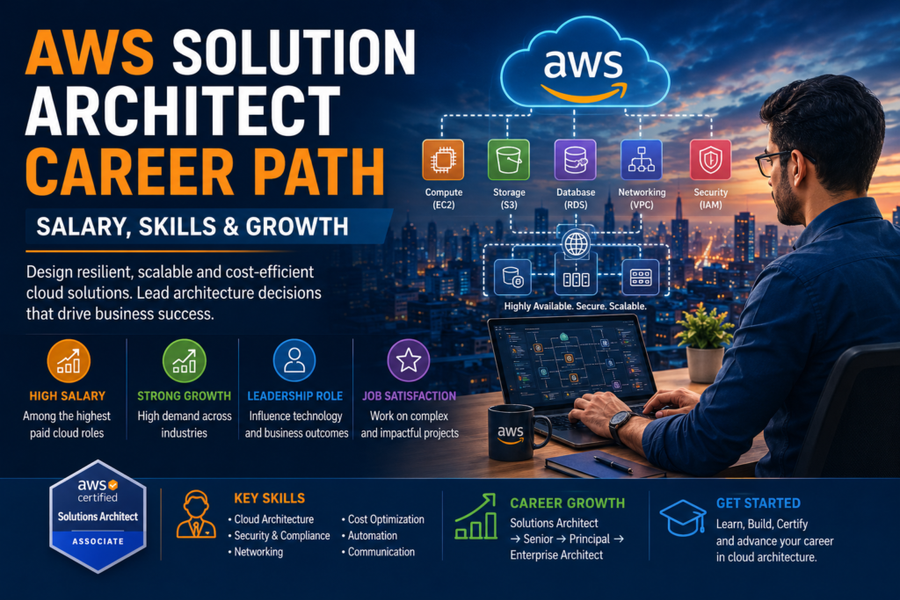
Design resilient, scalable and cost-efficient cloud solutions.
Skills That Separate Good Architects From Great Ones
Technical range matters, but it’s not the whole picture. A strong architect can explain networking concepts like VPC peering and transit gateways as easily as they can justify a cost-optimization decision to a non-technical stakeholder. Communication, in fact, is where many technically brilliant engineers stumble when moving into this role; you’re no longer just building the thing, you’re convincing a room full of people why it should be built that way.
The technical core generally includes compute and container services, identity and access management, multi-region networking, and cost governance. But the differentiator at senior levels is almost always security-by-design thinking: architects who bake in least-privilege access and encryption from day one, rather than retrofitting it after an audit flags a gap.
Learning Environments That Actually Prepare You
Reading documentation only gets you so far; this role is learned by breaking things in a safe sandbox. This is where structured programs, including several well-regarded AWS courses in Chennai, have become a genuine advantage for learners in the region. The city’s growing concentration of product companies and GCCs (global capability centers) has pushed local training providers to align their labs closely with real enterprise scenarios multi-account setups, VPC design exercises, and cost-optimization case studies rather than just exam cram sessions.
If you’re evaluating a program anywhere, not just locally, the test is simple: does it give you console access to build something end-to-end, or does it just walk you through slides? The former builds architects; the latter only builds exam-passers.
Comparing This Role to Its Closest Cousins
| Role | Primary Focus | Typical Deliverable | Works Closely With |
| Solutions Architect | System design and trade-off decisions | Architecture diagrams, design docs | Engineering leads, stakeholders |
| DevOps Engineer | Automation and deployment pipelines | CI/CD workflows, infrastructure as code | Developers, SRE teams |
| Cloud Consultant | Client-facing strategy and migration planning | Migration roadmaps, cost assessments | External clients, sales teams |
Design resilient, scalable and cost-efficient cloud solutions.
Mapping Out Your Next Two Years
If you’re starting from a generalist developer or sysadmin background, a realistic timeline looks like this: spend the first three to four months building foundational cloud knowledge and passing the Associate-level exam, then spend six to eight months applying that knowledge on real projects even side projects count if they involve genuine architectural decisions. Around month twelve, start preparing for the Professional-level exam while simultaneously seeking architect-adjacent responsibilities at your current job, even informally. By month eighteen to twenty-four, you should have enough of a portfolio and interview-ready stories to make a credible case for a dedicated architect title.
Closing Thoughts
The Solutions Architect path rewards people who enjoy connecting dots rather than staring at a single screen all day. It pays well, yes, but the real compensation is the seat at the table when decisions that shape a company’s entire cloud footprint get made. Get the certification, build something real with your own hands, and be ready to explain the “why” behind every architectural choice. That combination, more than any single exam score, is what actually gets you hired into this role.
FAQ
- How much does an AWS Solutions Architect earn compared to a developer? Solutions Architects generally earn more than backend or full-stack developers at similar experience levels, largely because the role carries direct accountability for cost, security, and system reliability decisions.
- Do I need coding experience to become a Solutions Architect? Basic scripting and infrastructure-as-code familiarity help significantly, but deep programming expertise isn’t mandatory; architectural judgment and system design thinking matter more.
- How long does it take to become job-ready as a Solutions Architect? Most career switchers need twelve to eighteen months, combining certification study, hands-on lab work, and real or simulated architecture projects.
- Is the Solutions Architect Associate exam enough to get hired? It’s usually enough for entry-level architecture-adjacent roles, but Professional-level certification and demonstrable project experience are typically expected for dedicated architect titles.
- What industries hire the most Solutions Architects right now? Fintech, healthcare technology, e-commerce, and SaaS companies currently show the strongest demand, driven by cloud migration and cost-optimization initiatives.
- Are local training programs better than self-paced online courses? It depends on your learning style. Structured local programs with hands-on labs can accelerate readiness, especially for hands-on architecture practice, while disciplined self-study works well for independent learners.
- What’s the biggest mistake beginners make when pursuing this career? Treating certification as the end goal instead of pairing it with real deployment experience that can be discussed confidently in interviews.
- Can a Solutions Architect eventually become a CTO or VP of Engineering? Yes, many senior architects transition into technical leadership roles because the role already builds the cross-functional communication and system-level thinking those positions require.
Written by
Venkat Raman
Expert instructor and certified professional with extensive experience training working professionals for global certifications including PMP, AWS, CSM, and PSM.