Introduction
Whether you’re a student, software developer, cloud engineer, business analyst, or IT professional, learning Generative AI on AWS can open new career opportunities while helping you build real-world AI solutions. If you’re also planning to pursue an AWS Solutions Architect certification, understanding AWS AI services gives you a significant advantage because modern cloud architecture increasingly includes AI-powered workloads. This guide explains everything beginners need to know from the fundamentals of Generative AI to AWS services, practical use cases, learning paths, and career opportunities.
Why Generative AI Is Becoming an Essential Cloud Skill
AWS provides cloud services that make these capabilities accessible without requiring years of AI research experience. Instead of building complex machine learning infrastructure from scratch, developers can use managed services to integrate AI into applications quickly and securely. Organizations across industries, including healthcare, banking, retail, manufacturing, education, and logistics, are investing heavily in cloud-based AI solutions. As a result, professionals with cloud and AI expertise are becoming highly valuable. Many learners who enroll in AWS courses in Chennai are now combining cloud computing with Generative AI because employers increasingly expect professionals to understand both technologies together.
Understanding the AWS Services That Power Generative AI
One of AWS’s biggest strengths is offering multiple AI services that suit different skill levels. Beginners don’t need deep expertise in machine learning to start building intelligent applications.
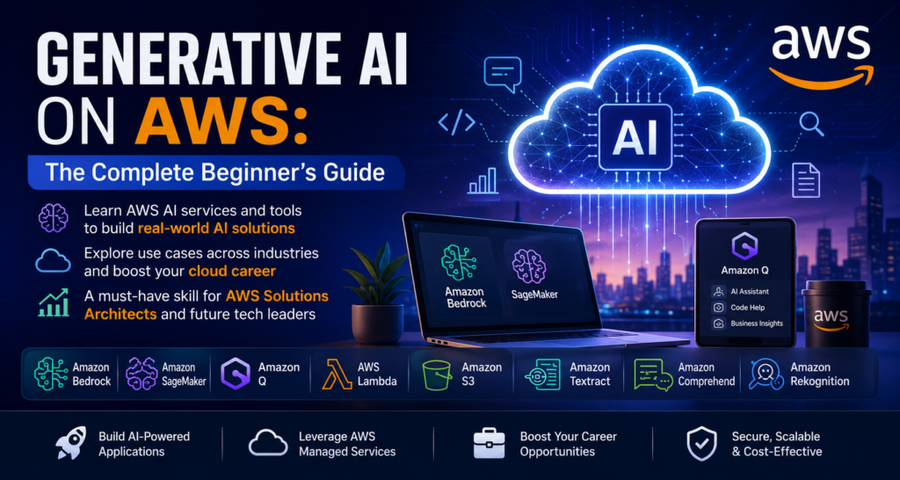
Some of the most important AWS services include:
- Amazon Bedrock for accessing foundation models through APIs
- Amazon SageMaker for building, training, and deploying machine learning models
- Amazon Q for AI-powered developer and business assistance
- AWS Lambda for serverless AI workflows
- Amazon S3 for secure data storage
- Amazon Textract for document intelligence
- Amazon Comprehend for natural language processing
- Amazon Rekognition for image analysis
Imagine a customer support portal where users upload documents. AWS can automatically extract information, summarize content using Generative AI, and generate accurate responses, all without maintaining complex infrastructure.
How Generative AI on AWS Works in Real Business Scenarios
The easiest way to understand Generative AI is through practical applications rather than technical theory. A retail company can use AI to generate personalized product descriptions for thousands of products in minutes. A financial institution can summarize lengthy reports into executive dashboards.
Healthcare organizations can assist medical professionals by organizing clinical documentation more efficiently. Software companies can accelerate development by generating code suggestions and technical documentation. Educational platforms can automatically create quizzes, study materials, and personalized learning recommendations.
Marketing teams can generate campaign ideas, email drafts, SEO content, and product descriptions while maintaining consistent brand messaging. These examples demonstrate why businesses are rapidly adopting AI-powered cloud solutions.
Professionals pursuing an AWS solutions architecture certification increasingly encounter scenarios where AI services are integrated into cloud architectures, making AI knowledge a valuable complement to cloud expertise.
Generative AI on AWS: The Complete Beginner's Guide
Difference Between Traditional AI and Generative AI
| Feature | Traditional AI | Generative AI |
| Primary Goal | Analyze existing data | Create new content |
| Output | Predictions, classifications | Text, images, code, audio, videos |
| Learning Focus | Pattern recognition | Content generation |
| Business Applications | Fraud detection, forecasting | Chatbots, content creation, code generation |
| User Interaction | Limited automation | Interactive conversations |
| Creativity | Low | High |
| AWS Services | SageMaker, Comprehend | Amazon Bedrock, Amazon Q |
A Beginner-Friendly Learning Roadmap for AWS Generative AI
Learning cloud AI becomes much easier when approached step by step instead of trying to master everything at once. Begin by understanding core cloud concepts such as computing, storage, networking, security, and IAM. Next, become comfortable with essential AWS services including EC2, S3, Lambda, CloudFormation, and CloudWatch. Once your cloud foundation is strong, start exploring AI services like Amazon Bedrock and Amazon SageMaker. Build small projects such as document summarizers, AI chatbots, automated FAQ assistants, or content generators. As your confidence grows, study cloud architecture best practices, security principles, monitoring, scalability, and cost optimization. Students searching for structured instructor-led training often choose AWS courses in Chennai that combine hands-on cloud labs with real-world AI projects, making the learning journey more practical.
Career Opportunities After Learning Generative AI on AWS
The rapid adoption of AI has created demand across multiple technology roles.
Common career paths include:
- Cloud Engineer
- Solutions Architect
- AI Engineer
- Machine Learning Engineer
- DevOps Engineer
- Data Engineer
- Cloud Consultant
- AI Application Developer
- Cloud Security Engineer
- Technical Consultant
Employers value professionals who understand both cloud infrastructure and AI implementation, making this combination highly attractive in today’s technology job market.
Why AWS Certifications Strengthen Your AI Career
Learning practical skills is important, but professional certifications demonstrate validated expertise to employers.
Some of the major aws certification benefits include:
- Industry-recognized professional credibility
- Better career advancement opportunities
- Improved salary potential
- Strong understanding of cloud architecture
- Increased confidence in enterprise projects
- Better chances of passing technical interviews
- Access to broader cloud career opportunities
While certifications alone don’t guarantee employment, combining practical projects, AI knowledge, and recognized certifications creates a strong professional profile.
Many organizations actively seek candidates who understand cloud architecture alongside modern AI technologies, making certification preparation a worthwhile investment.
The growing popularity of AWS courses in Chennai reflects this trend, as learners increasingly seek programs that combine certification preparation with practical AI implementation.
Best Practices for Beginners Starting with AWS Generative AI
Success in cloud AI doesn’t require mastering everything immediately. Focus on building practical knowledge through consistent learning and experimentation.
Start with free AWS resources and documentation before moving to advanced projects.
Practice using Amazon Bedrock through simple prompt-based applications.
Understand responsible AI principles, including data privacy, security, fairness, and ethical AI usage.
Build a portfolio containing chatbot applications, document summarizers, recommendation systems, or AI-powered productivity tools.
Stay updated with AWS announcements because Generative AI evolves rapidly, with new services and capabilities introduced regularly.
Most importantly, prioritize solving real business problems instead of simply learning tools.
Conclusion
Generative AI is no longer a future technology; it is already transforming how businesses build applications, automate operations, and improve customer experiences. AWS makes this transformation accessible through managed services that allow beginners to develop AI-powered solutions without extensive machine learning expertise. Whether your goal is to become a cloud engineer, solutions architect, AI developer, or technology consultant, combining cloud computing knowledge with Generative AI skills positions you for long-term career growth.
FAQ
1. What is Generative AI on AWS?
Generative AI on AWS refers to using AWS cloud services like Amazon Bedrock and SageMaker to build applications that can generate text, images, code, summaries, and other AI-generated content.
2. Do I need machine learning experience to learn AWS Generative AI?
No. Beginners can start with managed AWS AI services that simplify model access and deployment without requiring deep machine learning expertise.
3. Is AWS Solutions Architect certification useful for AI professionals?
Yes. It helps professionals understand cloud architecture, security, scalability, and deployment strategies that are essential for implementing AI solutions.
4. Are AWS courses in Chennai suitable for beginners?
Many training programs are designed for beginners and include foundational AWS concepts, hands-on labs, certification preparation, and introductory Generative AI projects.
5. What are the main AWS certification benefits?
Key benefits include industry recognition, improved job prospects, stronger cloud expertise, career advancement opportunities, and increased employer confidence.
6. Which AWS service is best for starting with Generative AI?
Amazon Bedrock is one of the easiest services for beginners because it provides access to foundation models through managed APIs without requiring infrastructure management.
7. Which industries use Generative AI on AWS?
Healthcare, banking, retail, manufacturing, education, logistics, software development, media, and customer support are among the many industries adopting AWS-powered Generative AI.
8. How long does it take to learn Generative AI on AWS?
With consistent study and hands-on practice, beginners can understand the fundamentals in a few weeks, while developing job-ready skills typically takes several months depending on prior cloud experience.
Written by
Venkat Raman
Expert instructor and certified professional with extensive experience training working professionals for global certifications including PMP, AWS, CSM, and PSM.