Introduction
If you’re weighing whether a certification is worth your time and money in 2026, here’s the short answer: yes, provided you pick the right one and actually use it to build real skills, not just add a line to your resume. The market for trained facilitators who can run sprints, remove blockers, and keep teams honest about their commitments hasn’t slowed down if anything, hybrid and AI-augmented product teams need this role more than ever. Let’s walk through what the certification actually teaches you, what it pays, and how to choose among the crowded field of options without wasting your budget.
Why Companies Still Pay a Premium for Certified Facilitators
A lot of people assume that once a company goes “agile,” anyone can run a standup. In practice, teams without a trained facilitator tend to drift; sprints get overloaded, retrospectives turn into complaint sessions, and stakeholders stop trusting the roadmap. This is where the agile scrum master earns their keep. The role isn’t about ceremony-keeping; it’s about protecting the team’s focus, coaching product owners on backlog health, and translating chaos into a predictable delivery rhythm.
Hiring managers in 2026 are specifically screening for candidates who can show they’ve handled distributed teams, AI-assisted development pipelines, and cross-functional squads spanning data, design, and engineering. A credential alone won’t get you hired, but it does get your resume past the first filter, and it gives you a shared vocabulary story points, velocity, sprint burndown that speeds up onboarding into a new organization.
What You Actually Learn (Beyond the Buzzwords)
Most training programs cover the same foundational ground: sprint planning, daily standups, sprint reviews, and retrospectives. But the better ones go further, teaching conflict resolution, stakeholder management, and metrics literacy, knowing whether a dip in velocity signals a real problem or just noise. A well-designed course will also push you to practice facilitation under pressure, since the hardest part of the job isn’t knowing the Scrum framework; it’s holding a room together when priorities clash mid-sprint.
Here’s a practical example: imagine a mobile app team that keeps missing sprint goals because the product owner keeps injecting “urgent” tickets mid-cycle. A trained facilitator doesn’t just enforce the rulebook; they coach the product owner on backlog discipline, run a data-backed conversation about the cost of context-switching, and negotiate a buffer for genuine emergencies. That’s the kind of applied judgment certification programs are increasingly designed to build, not just test.
The Real Benefits of Scrum Master Certification for Your Career
The benefits of scrum master certification go well beyond a badge on LinkedIn. First, it standardizes your knowledge; you stop relying on whatever ad hoc process your last employer used and instead learn the framework as it’s meant to work. Second, it opens doors into industries beyond software: healthcare, finance, and even manufacturing teams now run agile delivery models and specifically look for certified facilitators to lead the transition.
Third, and often underrated, is the network effect. Certification communities, alumni groups, local meetups, and online forums become a genuine source of job leads and mentorship. Fourth, certified professionals tend to command better starting offers because employers see the credential as proof you won’t need months of hand-holding before you’re productive. Finally, many certifications require renewal through continuing education, which keeps you current instead of coasting on knowledge from five years ago when agile practices were less mature around remote and AI-assisted workflows.
Salary Expectations Across Experience Levels in 2026
Compensation varies widely by region, industry, and company size, but a few patterns hold steady. Entry-level facilitators, typically transitioning from project coordination or QA roles, tend to land in the lower-to-mid range of the market. Mid-career professionals with three to five years of hands-on sprint facilitation, especially those who’ve led multiple teams simultaneously, see a noticeable jump. Senior-level practitioners often functioning as agile coaches across several squads command the highest pay, particularly at companies undergoing large-scale digital transformation.
Geography still matters enormously. Facilitators in major tech hubs or at companies with fully remote global teams often out-earn peers in smaller regional markets, partly because those companies compete for talent against big tech directly. Industry matters too: fintech and healthtech companies, under pressure to ship compliant software quickly, tend to pay above the median for experienced facilitators who understand regulatory constraints alongside agile processes.
Choosing the Best Agile Scrum Certification for Your Goals
Not all credentials are created equal, and picking the best agile scrum certification depends on where you’re starting from and what kind of organization you want to work in. If you’re brand new to the framework, an entry-level foundational course focused on core ceremonies and roles makes sense. If you already have hands-on experience, an advanced or coaching-track credential that emphasizes scaling frameworks across multiple teams will serve you better and signal seniority to employers.
Before you enroll, check three things: whether the syllabus includes hands-on simulations rather than pure theory, whether it’s in your target industry, and whether the program offers a community or mentorship component after you finish. A certificate that just tests memorization of terminology won’t prepare you for the messy reality of a team in conflict, and that’s ultimately what you’re being hired to manage.
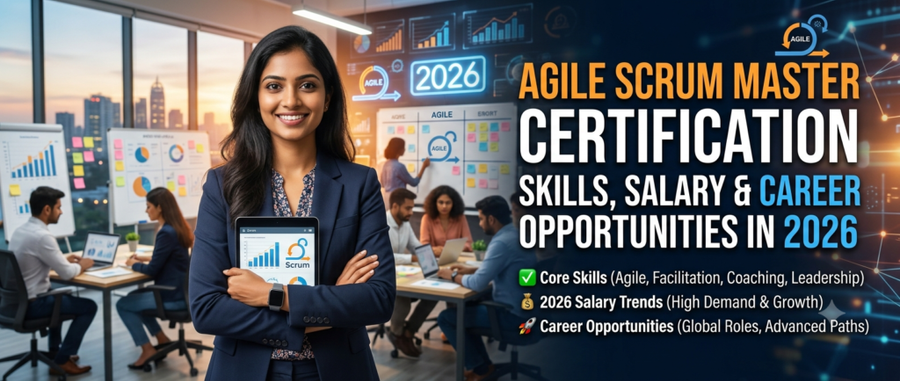
Agile Scrum Master Certification: Skills, Salary & Career Opportunities in 2026
Difference Between Entry-Level and Advanced Scrum Certification
| Aspect | Entry-Level Certification | Advanced/Coaching-Level Certification |
| Focus | Core ceremonies, roles, terminology | Scaling agile across multiple teams, organizational coaching |
| Ideal Candidate | New to agile, transitioning careers | Experienced facilitators, aspiring agile coaches |
| Typical Duration | 2–3 days of training | Weeks to months, often with mentorship |
| Salary Impact | Moderate boost to entry offers | Significant boost, opens senior/coach roles |
| Assessment Style | Multiple-choice exam | Case studies, live facilitation assessment |
| Renewal Requirement | Usually periodic, low-effort | Ongoing continuing education and practical hours |
Building a Career Path That Actually Compounds
Getting certified is the starting line, not the finish line. The professionals who build lasting careers as an agile scrum master treat the first year after certification as an apprenticeship: they volunteer for the hardest teams, ask for feedback from product owners and engineers alike, and track their own metrics honestly instead of only presenting good news upward. Over time, many transition into agile coaching, program management, or even product leadership, because the skills facilitation, conflict navigation, data-informed decision-making transfer directly.
It also helps to specialize. A facilitator who understands DevOps pipelines, or who’s fluent in scaling frameworks for multi-team programs, or who can speak the language of a regulated industry like healthcare, becomes far harder to replace than a generalist. In 2026’s job market, where AI tools are automating a lot of routine status reporting, the human judgment a skilled facilitator brings reading team morale, mediating disagreements, protecting focus is precisely the part of the job that’s hardest to automate.
Final Thoughts
The role of a certified facilitator isn’t going anywhere in 2026; if anything, as teams get more distributed and tool-heavy, the need for someone who can hold the human side of delivery together has grown. Whether you’re just starting or looking to level up into coaching, the right credential paired with real practice remains one of the more reliable ways to build a durable, well-paid career in modern product delivery.
FAQ
- Is a scrum master certification worth it in 2026?
Yes, particularly for professionals moving into project or product delivery roles. It shortens the learning curve and helps you pass initial resume screens, though real-world facilitation skill still matters more for long-term success.
- What is the average salary after getting certified?
Salaries vary by region and experience, but certified facilitators generally earn more than uncertified peers doing the same work, with the biggest jumps coming from three-plus years of hands-on team facilitation.
- How long does it take to get certified?
Entry-level courses typically run two to three days plus an exam, while advanced or coaching-track certifications can take several weeks to months, especially if they include mentorship or practical assessments.
- Do I need a technical background to become a scrum master?
No. While understanding basic software development concepts helps, the role is fundamentally about facilitation, communication, and process discipline rather than coding.
- What industries hire certified scrum masters besides tech?
Healthcare, finance, manufacturing, and government agencies increasingly hire certified facilitators as they adopt agile delivery models for non-software projects too.
- Can I become a scrum master without any prior experience?
Yes, many professionals transition from project coordination, QA, or business analyst roles. Certification plus a willingness to start on smaller teams is often enough to break in.
- What’s the difference between a scrum master and a project manager?
A scrum master facilitates a self-organizing team and protects the agile process, while a traditional project manager typically owns scope, budget, and timeline decisions directly. The roles overlap but aren’t identical.
- How do I choose between competing certification providers?
Look for hands-on simulation components, recognition among employers in your target industry, and post-certification community or mentorship support rather than choosing based on price alone.
Written by
Venkat Raman
Expert instructor and certified professional with extensive experience training working professionals for global certifications including PMP, AWS, CSM, and PSM.