Introduction
Project management has become one of the most valuable skills across industries, from IT and healthcare to construction, finance, manufacturing, and consulting. Organizations are constantly searching for professionals who can deliver projects on time, within budget, and with measurable business value. That’s why earning a PMP certification is considered a major milestone for professionals who want to advance into leadership roles.
If you’re wondering where to begin, this roadmap explains every stage of the journey—from learning the fundamentals to passing the PMP exam and becoming a confident project manager. Whether you’re a recent graduate, a working professional, or someone planning a career switch, this guide will help you understand the skills, training, and preparation required to succeed.
Why PMP Certification Continues to Be a Career Accelerator
Modern organizations manage multiple projects simultaneously, making experienced project managers indispensable. Companies seek professionals who understand project planning, stakeholder communication, budgeting, scheduling, quality management, and risk mitigation.
PMP certification validates these skills through a globally recognized credential that demonstrates both theoretical knowledge and practical experience.
Professionals with PMP certification often experience:
- Better career opportunities
- Higher salary potential
- Greater leadership responsibilities
- Improved project delivery skills
- Increased credibility with employers and clients
Unlike general management certifications, PMP focuses on real-world project execution, making it valuable across almost every industry.
Stage 1: Build a Strong Foundation in Project Management
Every successful project manager starts by understanding the fundamentals before attempting advanced certifications.
Focus on learning:
- Project lifecycle
- Agile and Hybrid methodologies
- Waterfall methodology
- Scope management
- Schedule planning
- Cost estimation
- Risk management
- Communication planning
- Stakeholder engagement
- Team leadership
Many beginners start with the best online project management certificate because it provides structured learning before moving toward PMP certification.
A beginner-friendly certification helps learners understand industry terminology while developing practical knowledge through case studies and real business scenarios.
For example, someone working as a software developer may already coordinate tasks, collaborate with teams, and manage deadlines. Learning formal project management frameworks transforms these everyday responsibilities into recognized project management competencies.
Stage 2: Choose the Right Training That Matches PMP Requirements
One of the biggest mistakes candidates make is selecting training solely based on price.
Instead, evaluate the overall learning experience.
A quality PMP certification training course online should include:
- Complete PMBOK-based curriculum
- Agile and Hybrid project management concepts
- Mock examinations
- Practice questions
- Instructor-led sessions
- Real-world case studies
- Lifetime access to learning materials
- Exam preparation strategies
Similarly, comprehensive training courses for project management should focus on practical implementation rather than memorization.
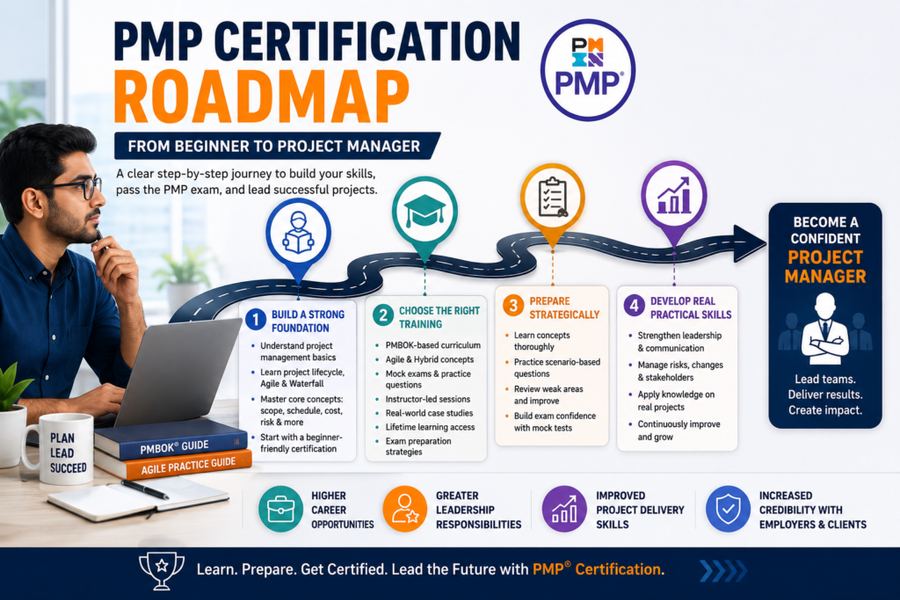
PMP Certification Roadmap From Beginner To Project Manager
Stage 3: Prepare Strategically Instead of Simply Studying Longer
Many PMP candidates assume success depends on studying more hours. In reality, success depends on studying smarter.
A structured preparation plan typically includes four phases.
Learn the Concepts
Begin by understanding project management principles instead of memorizing definitions.
Practice Scenario-Based Questions
The PMP exam emphasizes decision-making rather than factual recall.
For example:
A project encounters unexpected stakeholder resistance midway through execution. Instead of asking for a definition, the exam may ask what the project manager should do first.
This approach measures practical thinking.
Review Weak Areas
Track your mock exam performance and identify recurring mistakes.
Build Exam Confidence
Quality PMP exam training online programs simulate the actual examination experience, helping candidates improve both speed and accuracy before exam day.
Consistent practice is often more effective than last-minute intensive study.
Stage 4: Develop Real Project Management Skills Beyond the Certification
Passing the exam is only the beginning.
Great project managers continuously improve skills such as:
- Leadership
- Negotiation
- Conflict resolution
- Resource allocation
- Risk analysis
- Strategic planning
- Change management
- Customer communication
Imagine managing a software implementation project involving developers, testers, designers, clients, and senior management. Success depends not only on technical knowledge but also on communication, stakeholder alignment, and proactive risk management.
This practical expertise transforms certified professionals into successful project leaders.
PMP Certification vs General Project Management Certificates
| Feature | Best Online Project Management Certificate | PMP Certification |
| Experience Required | Usually Beginner-Friendly | Professional Experience Required |
| Difficulty | Moderate | Advanced |
| Primary Goal | Learn Fundamentals | Validate Professional Expertise |
| Practical Knowledge | Basic to Intermediate | Advanced Project Leadership |
| Global Recognition | Varies | Internationally Recognized |
| Career Growth | Entry-Level Opportunities | Mid to Senior-Level Roles |
| Best For | Beginners | Experienced Professionals |
PMP Certification Roadmap From Beginner To Project Manager
Common Challenges Candidates Face—and How to Overcome Them
Many aspiring project managers encounter similar obstacles throughout their certification journey.
Balancing Work and Study
Create a realistic weekly study schedule rather than attempting long weekend sessions.
Understanding Agile Concepts
Modern PMP exams include significant Agile content.
Select training courses for project management that integrate Agile, Scrum, and Hybrid methodologies.
Managing Information Overload
Avoid using multiple unrelated resources simultaneously.
Instead, follow one structured PMP certification training course online and supplement it with mock exams.
Exam Anxiety
Taking multiple full-length practice exams through PMP exam training online helps reduce stress and improves confidence.
Industry Trends Every Future Project Manager Should Know
Project management continues evolving rapidly.
Today’s employers increasingly expect project managers to understand:
- Artificial Intelligence in project planning
- Predictive analytics
- Agile transformations
- Hybrid project delivery
- Digital collaboration platforms
- Cloud-based project management tools
- Data-driven decision-making
- Business value realization
Organizations no longer seek professionals who simply manage schedules.
They want leaders who align projects with strategic business objectives while adapting quickly to changing priorities.
Developing these skills alongside PMP certification significantly improves long-term career prospects.
How to Choose the Right Online PMP Training Provider
Before enrolling, evaluate providers using these criteria:
- Updated curriculum aligned with current PMP standards
- Experienced instructors with real industry knowledge
- Interactive learning sessions
- Comprehensive mock examinations
- Flexible learning schedules
- Student support
- Practical case studies
- Positive learner success stories
The ideal PMP certification training course online should prepare candidates not only to pass the examination but also to manage real projects confidently after certification.
Conclusion
Becoming a successful project manager is a journey rather than a single achievement. Building strong fundamentals, selecting quality learning resources, practicing consistently, and developing leadership skills all contribute to long-term success. Whether your goal is career advancement, higher earning potential, or leading impactful projects, following a structured PMP certification roadmap is one of the smartest investments you can make in your professional future.
FAQ
1. Is PMP certification suitable for beginners?
PMP is designed for professionals with project management experience. Beginners often start with the best online project management certificate before pursuing PMP.
2. How long does it take to prepare for the PMP exam?
Most candidates prepare for three to six months, depending on their experience and study schedule.
3. Is PMP exam training online effective?
Yes. High-quality PMP exam training online programs provide structured learning, mock exams, and expert guidance that significantly improve exam readiness.
4. How do I choose the right PMP certification training course online?
Look for experienced instructors, updated course material, practical case studies, mock exams, and comprehensive learner support.
5. Are training courses for project management useful before PMP?
Absolutely. They build foundational knowledge and help beginners understand project management concepts before attempting PMP certification.
6. Which industries value PMP-certified professionals?
IT, construction, healthcare, manufacturing, banking, consulting, telecommunications, retail, government, and engineering all highly value PMP-certified project managers.
7. Does PMP certification improve salary opportunities?
Yes. PMP-certified professionals are often considered for higher-paying leadership roles because employers recognize their project management expertise.
8. Can I study for PMP while working full-time?
Yes. Most professionals successfully prepare using flexible PMP certification training course online programs that allow self-paced learning alongside full-time employment.
Written by
Venkat Raman
Expert instructor and certified professional with extensive experience training working professionals for global certifications including PMP, AWS, CSM, and PSM.