Introduction
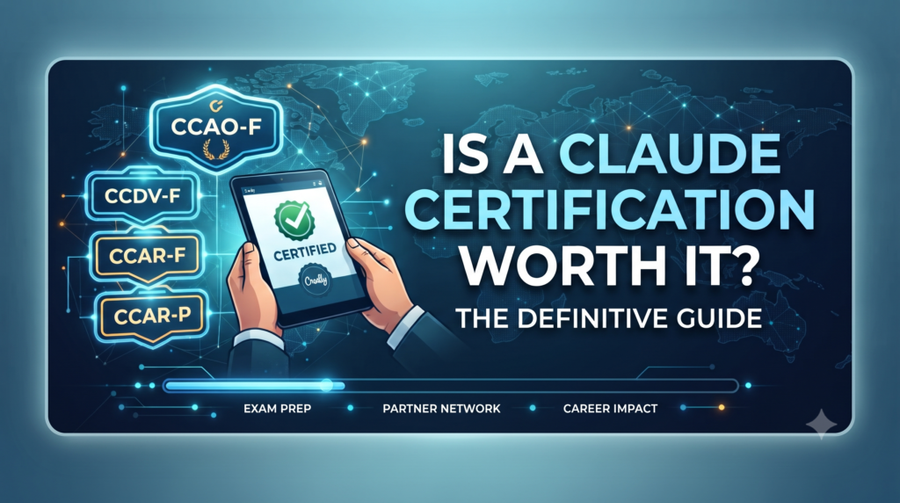
Is a Claude certification worth it? For some professionals, it plainly is, and for most it turns on one crucial question almost nobody checks first. Here is the honest arithmetic: the exam fee, the preparation time, and the gate that settles eligibility before either.
With enterprise adoption surging, organizations are moving past the basic question of whether to use generative AI. The real question today is who on the team actually knows how to use it safely, efficiently, and defensibly. This comprehensive guide breaks down the costs, role-based benefits, exam structures, and preparation strategies so you can decide if leaping makes sense for your career this year.
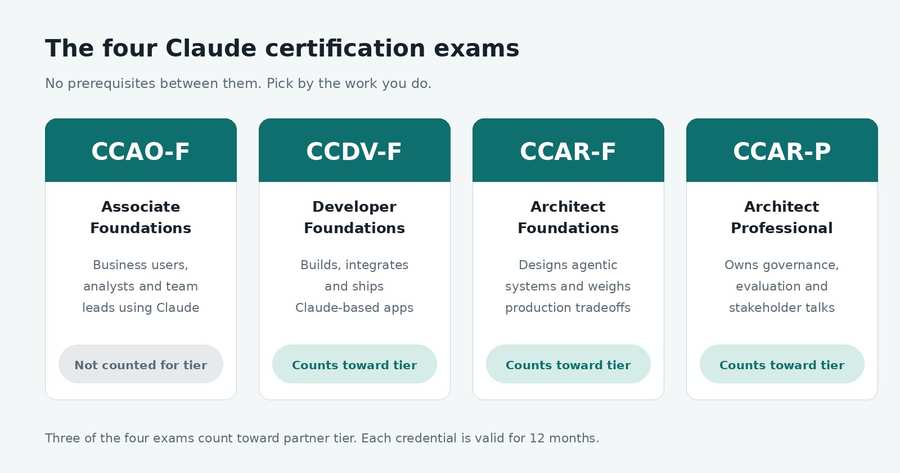 Is It Worth It for Your Role?
The honest test is three questions deep, starting with your organization’s partnership status. The second question relates to your day-to-day responsibilities. Using Claude casually is very different from making architectural or governance decisions about it.
Here is how the value breaks down across different professional personas:
| Persona | Which Exam | What Passing Gives You |
| Consultant | CCAO-F for advisory work; CCAR-P for system design | A verifiable Credly badge and a domain report highlighting where your judgment on escalation, validation, and governance stands. |
| Developer | CCDV-F | Independent proof that you can build, integrate, and ship Claude-based applications. |
| Architect | CCAR-F, then CCAR-P | Rigorous evaluation of tradeoff judgment across complex production scenarios and enterprise lifecycles. |
| Team Lead | Exams matching team roles | Contributes toward your organization’s partner tier standing while providing cohort analytics on team strengths and weaknesses. |
The Gate That Decides It First
Before debating Is a Claude certification worth it, you must check the foundational prerequisite: Claude certification exams are open exclusively to individuals affiliated with organizations in the Claude Partner Network.
Registration requires a valid work email on a recognized company domain. Personal email addresses are automatically rejected, meaning individual learners with no partner affiliation cannot book a seat directly. Membership in the partner network is free to apply for, reframing the question from “Is this worth $99?” to “Is this worth asking my employer to join the network?” Settle this eligibility gate before committing to any study schedule.
What Passing Changes
The professional value of a Claude credential is narrow, concrete, and measurable:
Passing Score: 720 scaled score required out of 1000.
Validity: Valid for 12 months before requiring renewal.
Score Reports: Detailed breakdown by domain to identify specific strengths and weaknesses for performance reviews.
Partner Tier Contribution: Three of the four available exams count directly toward elevating your organization’s partner tier status.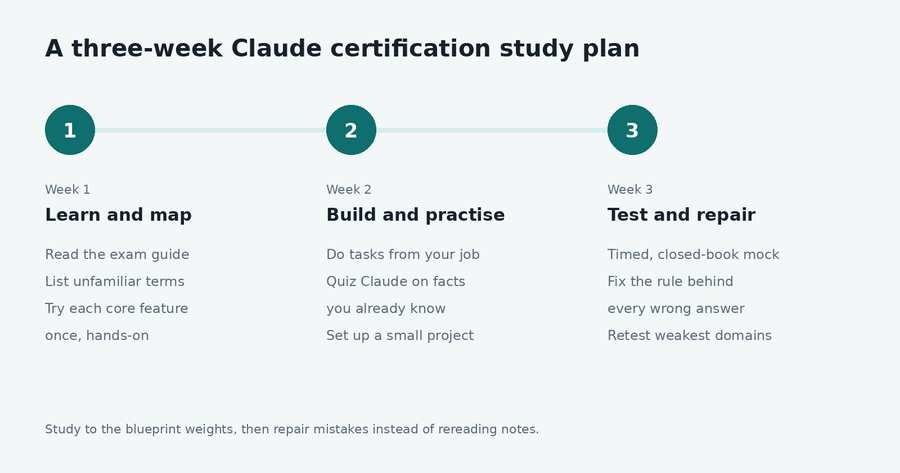
Where the Preparation Goes
Preparation is where candidates succeed or struggle. The exams do not distribute weight evenly across topics. For instance, the Claude Certified Associate Foundations blueprint places heavy emphasis on evaluation rather than basic prompting:
Output Evaluation and Validation is the heaviest domain at 21%, which is where the most common failure pattern occurs: accepting a fluent, confident AI response as absolute proof of correctness. Governance and risk follow closely behind, while basic prompting accounts for only 14% of the exam.
When planning your study roadmap—whether aiming for an associate credential or a technical Claude Certified Architect Foundations path—understanding these weights ensures you allocate your hours effectively. Running structured passes (learning, building, testing closed-book under timed conditions, and repairing wrong answers) bridges the gap between casual familiarity and exam readiness.
Decide It in Five Minutes
Work through these four quick checks to make your final decision:
Check the gate first: Verify if your employer is in the Partner Network and test your work email registration.
Name who counts it: Identify if your manager, client, or company tier requires or rewards the credential.
Pick by role, not level: Choose the exam matching your actual daily responsibilities rather than assuming “Foundations” means beginner.
Review your capacity: Assess your schedule to commit to a rigorous 3-week study and practice plan without burnout.
Preparing for Success: Study Strategies
Preparation requires shifting away from passive reading toward active, scenario-based problem-solving. Exam questions typically present realistic enterprise business challenges, asking candidates to choose the most defensible, efficient, and secure course of action.
Study the Blueprint: Focus heavily on high-weight domains like Output Evaluation, Safety Alignment, and Risk Governance.
Take Timed Practice Mocks: Simulate real testing conditions to build pacing, stamina, and exam-day confidence.
Review Incorrect Answers: Analyze why distractor options fail to meet strict enterprise safety or engineering standards.
Conclusion
If your daily role requires regular interaction with advanced LLMs, or if your organization values validated technical readiness, an official credential can provide significant professional leverage. By understanding the eligibility criteria, investment structure, and preparation strategy, you can confidently decide whether this credential aligns with your career goals.