Introduction
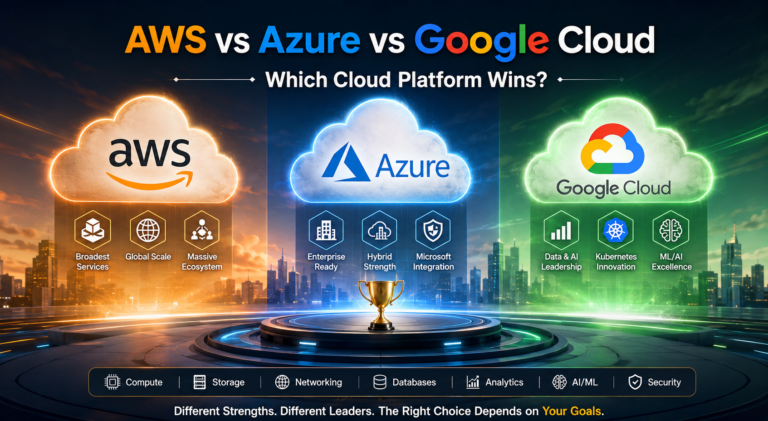
If you’re standing at the crossroads of choosing a cloud platform—whether for your business, your next project, or your career—you want a straight answer, not a sales pitch. Here it is upfront: AWS wins on market share and maturity, Azure wins on enterprise integration, and Google Cloud wins on data and AI workloads. But the real answer depends entirely on what you’re building and where you want your skills to take you. Let’s break this down properly.
The Cloud Wars: Why This Comparison Actually Matters in 2025
Cloud computing isn’t a side conversation anymore—it’s the backbone of nearly every modern business. Netflix runs on AWS. LinkedIn leans heavily on Azure. Spotify built much of its infrastructure on Google Cloud. Each of these giants picked a platform based on specific needs, not brand loyalty. That’s the mindset you need too.
The three major players—Amazon Web Services, Microsoft Azure, and Google Cloud Platform—together control over 60% of the global cloud infrastructure market. AWS still leads with roughly a third of that pie, followed by Azure, then Google Cloud. But raw market share doesn’t tell you which platform will serve your specific use case best.
AWS: The Undisputed Pioneer With the Deepest Toolbox
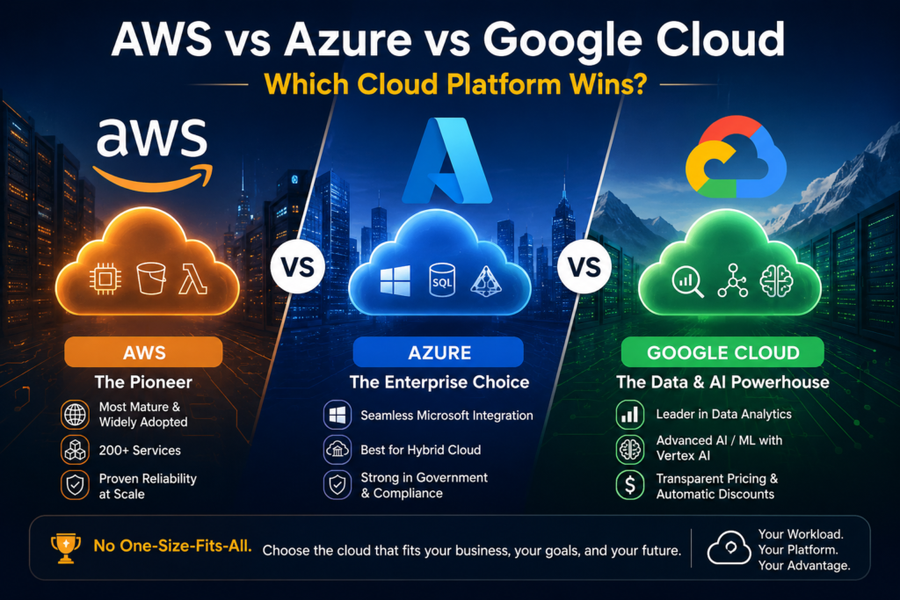
Amazon launched AWS back in 2006, giving it nearly two decades of head start. That maturity shows up in the sheer breadth of services—over 200 fully featured offerings spanning compute, storage, machine learning, IoT, and serverless computing. Startups love AWS because of its pay-as-you-go flexibility, while enterprises trust it because of proven reliability at massive scale.
This is also why professionals pursuing cloud careers often start with an aws solution architect certification. It’s widely considered the gold standard entry point into cloud architecture roles, and recruiters actively search for candidates holding it. The aws certification benefits are tangible—higher starting salaries, faster interview callbacks, and credibility when negotiating consulting rates. If you’re job-hunting in cloud infrastructure, this single credential can reshape your resume’s impact within months.
AWS’s biggest strength is ecosystem depth. Need a niche database engine, a specific compliance certification, or a global content delivery network with dozens of edge locations? AWS almost always has it already built and battle-tested.
Azure: The Enterprise Favorite Built for Microsoft Shops
If your company already runs on Windows Server, Active Directory, SQL Server, or Office 365, Azure integrates so naturally it barely feels like a separate platform. Microsoft designed Azure to be the path of least resistance for organizations already locked into its ecosystem.
Hybrid cloud is where Azure genuinely shines. Azure Arc and Azure Stack let large enterprises keep sensitive workloads on-premises while extending cloud capabilities where needed—something regulated industries like banking and healthcare care deeply about. Azure also holds a strong reputation in government contracting, partly due to Microsoft’s long-standing relationships with public sector clients.
Pricing-wise, Azure often works out cheaper for businesses with existing Microsoft licensing agreements, since enterprise agreement discounts stack nicely with Azure credits.
Google Cloud: The Quiet Powerhouse for Data and AI
Google Cloud doesn’t try to out-market AWS or Azure. Instead, it plays to Google’s core strength: data. If your business runs on big data analytics, machine learning pipelines, or Kubernetes-based container orchestration, Google Cloud often feels purpose-built for you—largely because Google invented Kubernetes and still maintains significant influence over its development.
BigQuery remains one of the most loved data warehousing tools in the industry, capable of querying petabytes of data in seconds without manual infrastructure tuning. Vertex AI has also become a serious contender for teams building and deploying machine learning models at scale, especially post the generative AI boom.
Google Cloud typically wins on pricing transparency too. Its per-second billing and sustained-use discounts (applied automatically, no upfront commitment needed) make cost forecasting simpler for lean engineering teams.
Choose the cloud that fits your goals, and your future
Difference Between AWS, Azure, and Google Cloud
Feature | AWS | Azure | Google Cloud |
Market Share | ~31% (largest) | ~24% | ~11% |
Best For | General-purpose, startups, enterprises | Microsoft-integrated enterprises, hybrid cloud | Data analytics, AI/ML, Kubernetes |
Pricing Model | Pay-as-you-go, complex tiers | Enterprise agreement discounts | Per-second billing, automatic discounts |
Compliance Strength | Extensive global certifications | Strong government/public sector | Strong in privacy-focused regions |
Learning Curve | Moderate to steep | Easier for Microsoft-familiar users | Moderate, developer-friendly |
Popular Certification | AWS Certified Solutions Architect | Azure Solutions Architect Expert | Google Professional Cloud Architect |
How Certification Choice Shapes Your Cloud Career Path
Here’s something many people overlook when comparing these platforms: your career trajectory often depends less on which cloud is “objectively better” and more on which ecosystem you build expertise in. Becoming an AWS-certified solutions architect doesn’t just validate technical knowledge—it signals to employers that you understand distributed systems, security best practices, and cost optimization at a professional level.
Compare that to Azure or Google Cloud certifications, which are respected but often carry slightly less market recognition simply due to AWS’s longer certification history and larger existing user base. That said, if your target employer runs entirely on Azure or Google Cloud, matching your certification to their stack matters more than chasing the “most popular” credential.
Many professionals actually pursue multi-cloud certifications over time. Starting with an AWS Solution Architect Certification, then branching into Azure or Google Cloud credentials later, creates a well-rounded profile that appeals to consulting firms and multinational companies running hybrid or multi-cloud environments—which, according to recent industry surveys, now describes the majority of large enterprises.
Real-World Scenarios: Picking the Right Platform for Your Situation
Imagine you’re a startup founder building a mobile app with unpredictable traffic spikes. AWS’s Lambda and auto-scaling EC2 instances handle unpredictable load gracefully, and the community support means you’ll find solutions to obscure errors within minutes on Stack Overflow.
Now imagine you’re an IT director at a mid-sized manufacturing company already running Microsoft 365 and on-premises Windows servers. Azure’s hybrid tools let you migrate gradually instead of ripping out existing infrastructure overnight.
Making Your Final Decision
There’s no single winner in the AWS vs Azure vs Google Cloud debate—context decides everything. AWS remains the safest default for broad, general-purpose workloads and offers the richest career opportunities through credentials like an AWS Solution Architect certification. Azure is unbeatable for organizations already invested in Microsoft’s ecosystem. Google Cloud dominates when your priority is data, analytics, and machine learning innovation.
Written by
Aabiance Technology
Expert instructor and certified professional with extensive experience training working professionals for global certifications including PMP, AWS, CSM, and PSM.