Introduction
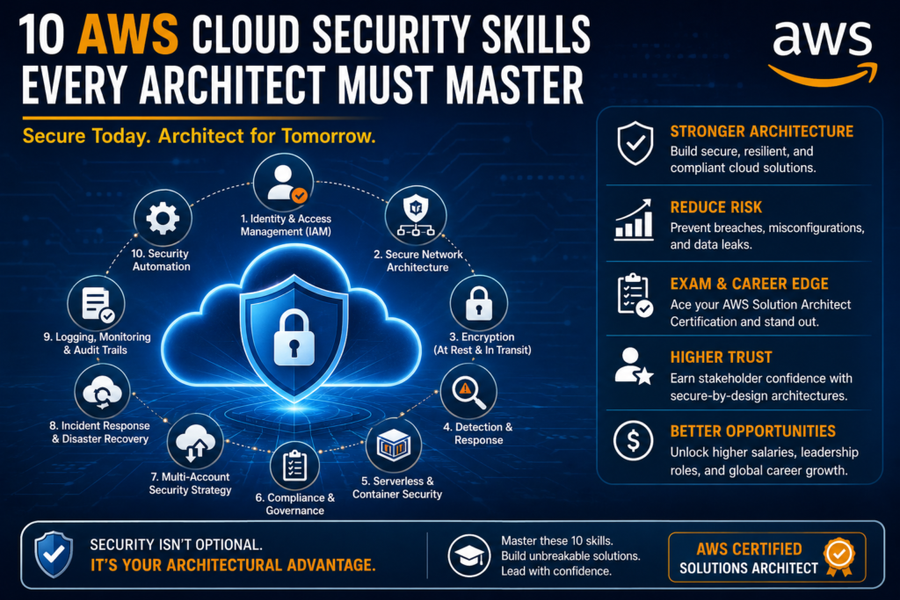
If you’ve ever watched a production environment, you already understand why cloud security isn’t optional — it’s the backbone of every architecture decision you’ll ever make. Security isn’t a bolt-on feature in AWS; it’s woven into every service, every IAM policy, and every network boundary you design. For architects pursuing an AWS Solutions Architect certification, mastering security isn’t just exam prep — it’s the difference between building systems that survive real-world attacks and ones that become cautionary tales in a post-mortem doc.
Why Security Fluency Defines Modern Cloud Architects
Cloud breaches rarely happen because AWS’s infrastructure failed — they happen because someone misconfigured a bucket policy or left a port open. Gartner has repeatedly noted that through 2026, the vast majority of cloud security failures will be the customer’s fault, not the provider’s. That single data point should reframe how you think about your role as an architect: you’re not just designing for scale and cost efficiency, you’re designing for resilience against human error and malicious actors alike.
Mastering Identity and Access Management (IAM) Beyond the Basics
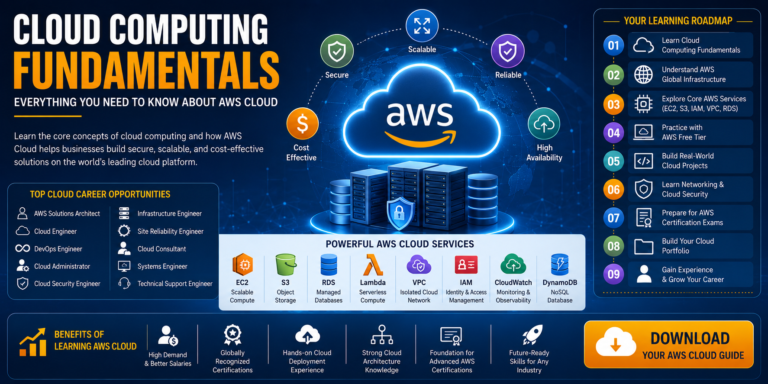
Most architects know IAM users, groups, and roles. Fewer understand the nuance of least-privilege policy design, permission boundaries, and service control policies (SCPs) across AWS Organizations. A skilled architect writes IAM policies that grant exactly what’s needed — nothing more — and regularly audits for privilege creep using IAM Access Analyzer.
Designing Secure Network Architectures with VPCs
A well-architected VPC isn’t just about subnets and route tables — it’s about creating defense-in-depth. This means private subnets for application and database tiers, NAT gateways instead of public IPs for outbound traffic, and security groups layered with network ACLs for redundant filtering. Architects also need fluency in VPC endpoints (Gateway and Interface) to keep traffic off the public internet entirely when accessing services like S3 or DynamoDB.
Building Detection and Response Capabilities
Prevention alone isn’t enough — architects must design for detection. This means enabling GuardDuty for threat intelligence, Security Hub for centralized findings, and CloudTrail with log file validation to maintain an immutable audit trail. Pairing these with EventBridge rules and Lambda functions creates automated remediation workflows, so a compromised credential gets disabled in seconds rather than hours.
Securing Serverless and Container Workloads
Security patterns shift dramatically when you move from EC2 to Lambda or ECS/EKS. Architects need to understand Lambda execution roles, VPC-attached functions, and secrets management via Secrets Manager instead of hardcoded environment variables. For containers, image scanning through ECR, task-level IAM roles, and network policies in EKS become essential rather than optional add-ons.
Compliance, Governance, and Multi-Account Strategy
Enterprise-grade architects design for governance at scale using AWS Organizations, Control Tower, and Config conformance packs. This ensures that every new account provisioned inherits guardrails automatically — no team can spin up an unencrypted S3 bucket or a public RDS instance without triggering alerts or outright denial.
Security isn't optional, It's Your Architectural Advantage.
Why These Skills Translate Into Real Career Value
Here’s where the conversation shifts from technical depth to career strategy. The AWS Certification Benefits aren’t abstract — they’re measurable in salary surveys, job postings, and hiring manager conversations. Global Knowledge’s IT Skills and Salary Report has consistently ranked AWS certifications among the highest-paying IT credentials worldwide, and security competency is frequently cited as the differentiator between mid-level and senior architect offers.
Practical Steps to Build These Skills Before Your Exam
Reading documentation only gets you so far. Spin up a sandbox AWS account and deliberately misconfigure resources, then use Security Hub and GuardDuty to detect your own mistakes. Build a small multi-tier application, encrypt everything end-to-end, and practice writing IAM policies from scratch rather than copying templates. This hands-on repetition is what transforms exam knowledge into workplace-ready instinct — and it’s exactly the kind of preparation that makes an AWS Solution Architect Certification feel earned rather than memorized.
Final Thoughts
Cloud security mastery isn’t a checkbox — it’s an ongoing discipline that evolves as AWS releases new services and attackers develop new techniques. Architects who internalize these ten skills don’t just pass exams; they build systems that organizations can actually trust with their most sensitive workloads.
Written by
Aabiance Technology
Expert instructor and certified professional with extensive experience training working professionals for global certifications including PMP, AWS, CSM, and PSM.