Introduction
Hiring managers today aren’t just scanning resumes for the word “cloud.” If you’re wondering exactly which skills separate an average AWS professional from one who gets hired fast and paid well, this guide breaks it down no fluff, just what recruiters and hiring panels actually screen for in 2026.
Why AWS Skills Have Become Non-Negotiable in Tech Hiring
Cloud budgets keep growing every year, and Amazon Web Services still commands the largest share of that spending among enterprises worldwide. That single fact changes how job descriptions get written. A role that once said “familiarity with servers preferred” now demands hands-on experience with EC2, Lambda, VPC design, and IAM policies. Employers aren’t asking whether you’ve heard of the cloud anymore; they’re asking whether you can architect on it, secure it, and troubleshoot it under pressure.
This shift is exactly why credentials like the AWS Solution Architect certification carry so much weight in interviews. It signals that a candidate has already been tested on real architectural scenarios, not just theoretical concepts picked up from a weekend course.
Core Technical Skills That Show Up in Almost Every Job Posting
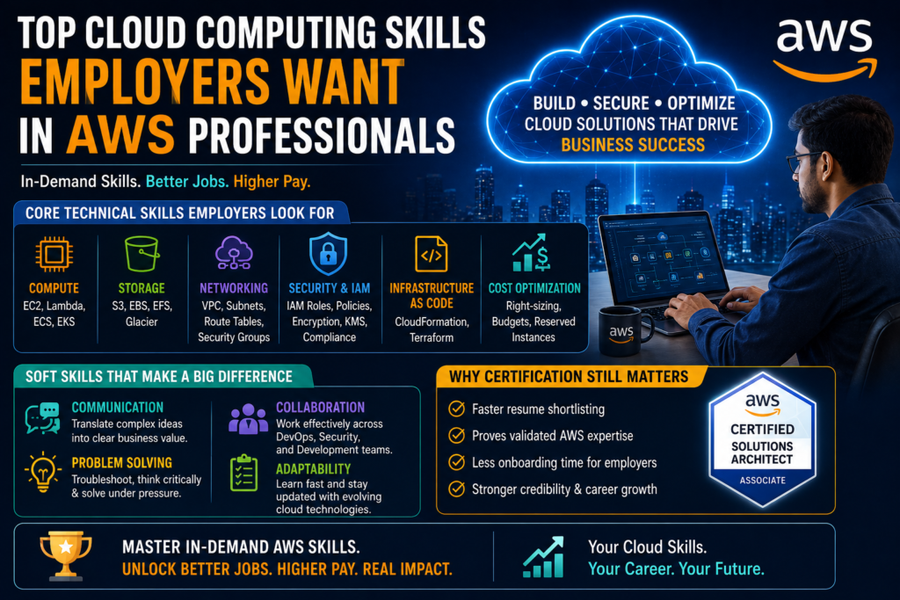
Strip away the buzzwords from most AWS job listings and you’ll find a recurring pattern. Employers want proficiency in compute services like EC2 and ECS, storage solutions like S3 and EBS, and networking fundamentals such as VPC, subnets, and route tables. Beyond that, Infrastructure as Code using CloudFormation or Terraform has become almost mandatory, since manual provisioning simply doesn’t scale in modern DevOps pipelines.
Security is another area where expectations have tightened considerably. Recruiters now expect candidates to speak confidently about IAM roles, encryption at rest and in transit, and compliance frameworks relevant to their industry. A professional holding an AWS Certified Solutions Architect credential typically demonstrates exactly this blend of technical depth paired with an understanding of governance and cost control.
Consider a mid-sized fintech company migrating its on-premises data center to AWS. The team doesn’t just need someone who can spin up instances; they need someone who understands multi-account strategy, disaster recovery planning, and how to keep the whole setup within a strict compliance budget. That’s the level of readiness employers are screening for now.
Soft Skills That Quietly Decide Who Gets the Offer
Technical chops get you shortlisted, but soft skills often decide who actually gets hired. Communication matters enormously in cloud roles because architects and engineers constantly translate technical trade-offs for non-technical stakeholders finance teams asking about cost, product managers asking about timelines, and executives asking about risk.
Problem-solving under ambiguity is another quiet differentiator. Cloud environments rarely fail in textbook ways; outages often stem from a combination of misconfigurations, third-party dependencies, and unexpected traffic spikes. Employers value candidates who can stay calm, isolate the root cause methodically, and document the incident clearly afterward rather than just patching the symptom.
Collaboration across DevOps, security, and development teams also ranks high. Cloud work rarely happens in isolation anymore, and someone who can bridge silos tends to move up faster than a purely technical specialist who prefers working alone.
Why Certification Still Matters When Experience Is King
There’s a persistent myth that certifications don’t matter once you have real-world experience. In practice, recruiters use certifications as a fast filtering mechanism, especially when they’re reviewing hundreds of applications for a single opening. Among the AWS Certification Benefits most frequently cited by hiring managers are faster resume screening, validated baseline knowledge, and reduced onboarding time since certified professionals typically require less hand-holding on AWS-specific terminology and workflows.
This doesn’t mean certification replaces experience it complements it. A candidate who pairs a recognized credential with two or three solid project examples on their resume tends to outperform someone with either credentials alone or experience alone, simply because they can prove both theoretical grounding and applied skill in the same conversation.
In-Demand Skills, Better Jobs, Higher Pay.
Difference Between AWS Certification Levels and What Employers Expect From Each
Certification Level | Typical Role Expectation | Employer Perception |
Cloud Practitioner | Entry-level, non-technical or junior technical staff | Basic cloud literacy, good for support or sales-engineering roles |
Associate (Solutions Architect, Developer, SysOps) | Hands-on engineers and junior architects | Can design and deploy standard workloads independently |
Professional (Solutions Architect Professional) | Senior architects, technical leads | Can handle complex, multi-account, hybrid-cloud environments |
Specialty (Security, Networking, ML) | Domain specialists | Deep expertise in a narrow, high-stakes area |
Emerging Skills Reshaping AWS Job Descriptions in 2026
The skill set employers demand keeps evolving alongside AWS’s own product roadmap. Right now, three areas are showing up in job postings far more often than they did even eighteen months ago. First, cost optimization using tools like AWS Cost Explorer and Trusted Advisor has become a standalone skill, not a nice-to-have, as companies tighten cloud budgets after years of unchecked spending. Second, familiarity with generative AI services such as Amazon Bedrock is increasingly expected, especially for architect-level roles building customer-facing AI features. Third, container orchestration knowledge, particularly EKS and Fargate, continues climbing job description checklists as more teams move away from monolithic deployments.
Professionals who can speak to all three areas, alongside a strong architectural foundation validated by something like an AWS Solution Architect Certification, tend to stand out immediately in technical screening rounds.
How to Actually Build These Skills Without Burning Out
Rather than trying to learn everything simultaneously, most successful candidates follow a layered approach. They start with foundational compute, storage, and networking concepts, move into hands-on labs using AWS’s free tier, and only then pursue certification once they can comfortably explain architectural trade-offs out loud not just click through a console tutorial.
Building a small personal project, like a serverless web app using Lambda and an API Gateway, does more for interview readiness than passively watching video courses. Employers consistently mention in feedback that candidates who can walk through a real project they built themselves come across as far more credible than those who only recite certification syllabus content.
Final Thoughts
The AWS job market has matured past the point where basic cloud awareness is enough to get hired. Employers now expect a blend of technical depth, security consciousness, cost discipline, and the soft skills needed to communicate all of it clearly across teams. Certification remains a smart, efficient way to prove baseline competence, but it works best when paired with genuine hands-on project experience.
Written by
Aabiance Technology
Expert instructor and certified professional with extensive experience training working professionals for global certifications including PMP, AWS, CSM, and PSM.