Introduction
Agile project management has become the preferred approach for organizations that want to deliver products faster, improve collaboration, and adapt quickly to changing customer needs. However, many professionals entering the Agile ecosystem often struggle to understand the differences between Agile, Scrum, Kanban, and SAFe. While these terms are closely related, they serve different purposes and are used in different organizational environments.
Whether you’re planning a career as an agile scrum master or looking to choose the Best Agile Scrum Certification, understanding these frameworks is essential. Each methodology offers unique advantages depending on the size of the team, project complexity, and business goals. This guide explains how Agile, Scrum, Kanban, and SAFe differ, where each framework fits best, and how certification can help professionals build successful careers in Agile project management.
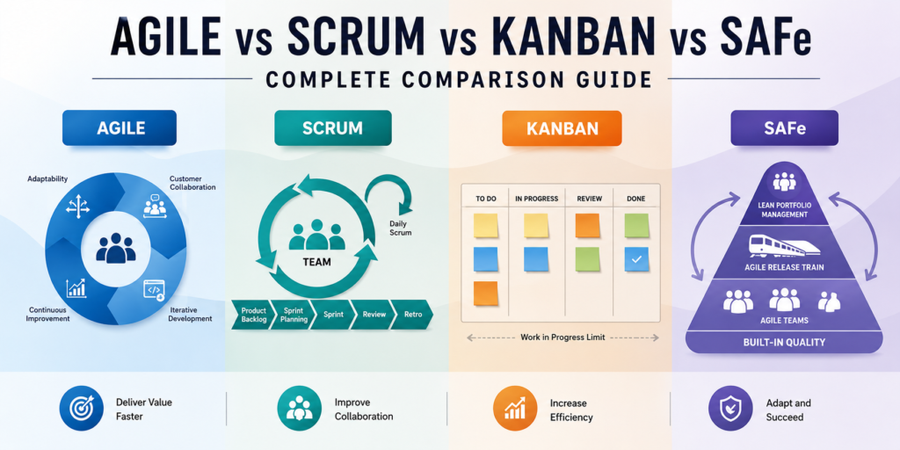
Agile: The Foundation of Modern Project Management
Agile is not a framework but a project management philosophy based on continuous improvement, customer collaboration, flexibility, and iterative development. Instead of following lengthy development cycles, Agile encourages teams to deliver small improvements regularly while adapting to feedback.
Organizations choose Agile because it improves transparency, reduces project risks, enhances communication, and increases customer satisfaction. Agile has become widely adopted across software development, healthcare, banking, manufacturing, education, and even government sectors.
Several frameworks have evolved from Agile principles, with Scrum, Kanban, and SAFe being among the most widely used.
A Structured Agile Framework
Scrum is one of the most popular Agile frameworks. It organizes work into fixed-length iterations known as Sprints, usually lasting two to four weeks. Every Sprint focuses on delivering a working product increment.
A Scrum team consists of three primary roles:
- Product Owner
- Scrum Master
- Development Team
The Scrum Master ensures Agile principles are followed while removing obstacles that prevent the team from achieving Sprint goals. This is one reason many professionals pursue an agile scrum master certification to gain expertise in facilitating Agile teams.
Organizations investing in Scrum often recognize the benefits of scrum master certification, including improved project delivery, stronger team collaboration, enhanced leadership skills, and better stakeholder communication.
Kanban: Continuous Flow Without Fixed Sprints
Unlike Scrum, Kanban does not divide work into Sprints. Instead, it focuses on continuous task flow using a visual Kanban board.
Every task moves through stages such as:
- To Do
- In Progress
- Review
- Completed
Kanban emphasizes limiting work in progress (WIP), reducing bottlenecks, and improving delivery speed.
Teams that handle continuous requests, customer support, maintenance, DevOps, and operations often prefer Kanban because priorities can change without waiting for a Sprint to finish.
Its simplicity makes Kanban easier to implement while maintaining high operational efficiency.
SAFe: Scaling Agile Across Large Enterprises
SAFe (Scaled Agile Framework) extends Agile principles across multiple teams working on enterprise-level projects.
Large organizations often have hundreds of employees working simultaneously on interconnected products. SAFe provides governance, planning, coordination, and portfolio management while maintaining Agile flexibility.
Key components include:
- Agile Release Trains
- Program Increment Planning
- Lean Portfolio Management
- Continuous Delivery Pipeline
- Built-in Quality Practices
SAFe is commonly adopted by multinational companies managing large digital transformation initiatives.
Agile, Scrum, Kanban, and SAFe: When Should You Choose Each?
- The right methodology depends on business objectives rather than popularity.
- Agile serves as the overall philosophy for adaptive project management.
- Scrum works best when projects require structured planning, defined roles, and predictable Sprint-based delivery.
- Kanban excels in environments where work arrives continuously, making flexibility and flow optimization more important than fixed timelines.
- SAFe becomes valuable when multiple Agile teams must coordinate across departments while aligning with strategic business objectives.
- Understanding these differences helps professionals choose the right framework for their organization and career path.
Agile vs Scrum vs Kanban vs SAFe: Complete Comparison Guide
Difference Between Agile, Scrum, Kanban, and SAFe
| Feature | Agile | Scrum | Kanban | SAFe |
| Type | Philosophy | Framework | Workflow Method | Enterprise Framework |
| Planning | Flexible | Sprint Planning | Continuous | Program Increment Planning |
| Work Style | Iterative | Time-boxed Sprints | Continuous Flow | Multi-team Coordination |
| Team Roles | Flexible | Defined Roles | No Mandatory Roles | Multiple Leadership Roles |
| Best For | Any Organization | Small to Medium Teams | Operations & Support | Large Enterprises |
| Workflow | Adaptive | Sprint Based | Visual Board | Enterprise Scaling |
| Metrics | Customer Value | Velocity | Cycle Time | Portfolio Performance |
Why Certification Matters in Agile Careers
As organizations increasingly adopt Agile practices, certified professionals are becoming highly valuable.
Choosing the Best Agile Scrum Certification helps professionals validate their skills, improve career opportunities, and qualify for leadership positions.
Many experienced professionals also pursue advanced scrum master training to deepen their understanding of Agile coaching, conflict resolution, enterprise Agile practices, stakeholder management, and large-scale Scrum implementation.
The long-term benefits of scrum master certification include:
- Better salary opportunities
- Increased global job prospects
- Strong leadership capabilities
- Higher credibility with employers
- Improved project delivery expertise
- Better understanding of Agile transformations
These certifications are valuable for software developers, project managers, business analysts, QA engineers, product owners, and aspiring Scrum Masters.
Agile vs Scrum vs Kanban vs SAFe: Complete Comparison Guide
Conclusion
Agile, Scrum, Kanban, and SAFe are not competing methodologies; they are complementary approaches designed for different project needs. Agile provides the guiding principles, Scrum introduces structured Sprint-based execution, Kanban optimizes workflow through continuous delivery, and SAFe enables enterprise-wide Agile transformation.
Choosing the right framework depends on project complexity, organizational size, team maturity, and business objectives. Professionals who understand these approaches and invest in the Best Agile Scrum Certification or advanced scrum master training gain a significant advantage in today’s competitive job market. If your goal is to become a successful agile scrum master, mastering these frameworks will prepare you to lead Agile teams with confidence while delivering measurable business value.
FAQ
1. What is the main difference between Agile and Scrum?
Agile is a project management philosophy, while Scrum is one of the frameworks used to implement Agile principles.
2. Is Kanban better than Scrum?
Neither is universally better. Scrum is ideal for structured development projects, whereas Kanban works well for continuous workflows and support teams.
3. What is SAFe used for?
SAFe helps large organizations coordinate multiple Agile teams working on enterprise-scale projects.
4. Who should become an agile scrum master?
Project managers, software engineers, business analysts, QA professionals, product owners, and team leaders can all benefit from becoming an agile scrum master.
5. What are the benefits of scrum master certification?
Certification improves leadership skills, career opportunities, salary potential, Agile expertise, and employer credibility.
6. Which is the Best Agile Scrum Certification for beginners?
Entry-level Scrum Master certifications are ideal for beginners, while experienced professionals can later pursue advanced credentials.
7. Is advanced scrum master training worth it?
Yes. It prepares professionals for Agile coaching, enterprise Agile implementation, leadership roles, and complex project environments.
8. Can Scrum, Kanban, and SAFe be used together?
Yes. Many organizations combine Scrum and Kanban practices while using SAFe to coordinate Agile work across multiple teams.
Written by
Venkat Raman
Expert instructor and certified professional with extensive experience training working professionals for global certifications including PMP, AWS, CSM, and PSM.