Introduction
Amazon Web Services (AWS) has become the foundation of modern cloud computing, powering startups, enterprises, government organizations, and global digital platforms. From scalable infrastructure and serverless computing to advanced analytics and artificial intelligence, AWS offers a comprehensive ecosystem that helps businesses innovate faster and operate more efficiently. As cloud adoption continues to grow, professionals with AWS expertise are increasingly sought after, particularly those with skills in cloud architecture, security, and solution design.
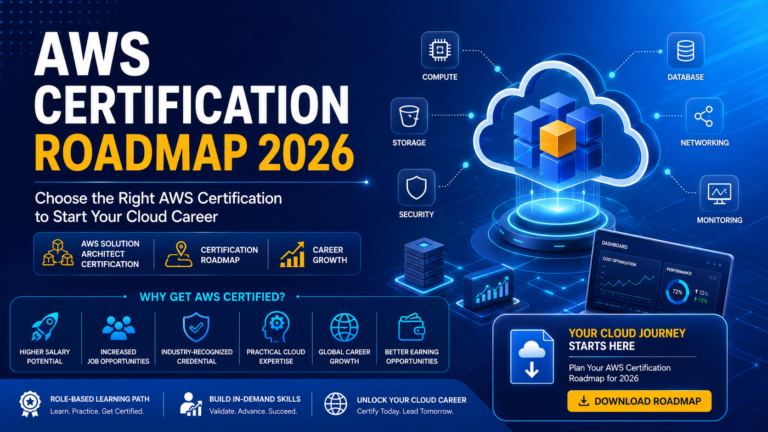
For individuals planning a cloud career, understanding AWS services, architectural principles, security controls, and certification pathways is essential. Many professionals begin by reviewing the AWS Solution Architect Certification Syllabus to understand the exam domains and the practical knowledge required for real-world cloud projects. Earning an AWS Solution Architect Certification not only validates technical expertise but also demonstrates the ability to design secure, scalable, and cost-effective cloud solutions. This article provides a comprehensive guide to AWS cloud services, architecture, security practices, and career opportunities, while highlighting the value of the AWS Solutions Architect Certification and the long-term benefits for IT professionals.
AWS Core Services and Their Business Value
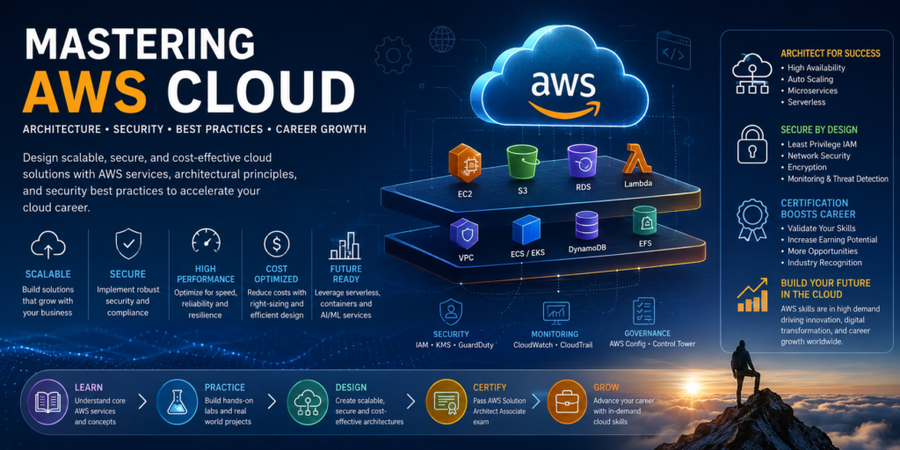
AWS provides hundreds of cloud services, but a strong foundation starts with understanding the core categories that are most commonly used in enterprise environments.
Compute Services
Compute services provide the processing power needed to run applications.
- Amazon EC2 (Elastic Compute Cloud): Virtual servers for hosting applications.
- AWS Lambda: Serverless computing that runs code without managing servers.
- Amazon ECS and EKS: Container orchestration for Docker and Kubernetes workloads.
Organizations use these services to build scalable applications, microservices architectures, and event-driven systems.
Storage Services
Data storage is a critical component of every cloud solution.
- Amazon S3: Object storage for files, backups, media, and data lakes.
- Amazon EBS: Block storage attached to EC2 instances.
- Amazon EFS: Shared file storage for Linux-based workloads.
S3 is particularly important because it supports high durability, lifecycle management, and integration with analytics and security services.
Database Services
AWS supports multiple database models.
- Amazon RDS: Managed relational databases such as MySQL and PostgreSQL.
- Amazon DynamoDB: NoSQL database for high-performance applications.
- Amazon Aurora: Cloud-optimized relational database with high availability.
Networking Services
Networking enables secure communication between cloud resources.
- Amazon VPC: Isolated virtual networks.
- Elastic Load Balancer: Traffic distribution across multiple instances.
- Amazon Route 53: DNS and routing management.
These services form the backbone of most AWS architectures and are heavily emphasized in the AWS Solution Architect Certification.
Designing Scalable AWS Architecture
A successful cloud solution is not just about deploying resources; it is about designing an architecture that can scale, recover from failures, and optimize costs.
High Availability Across Availability Zones
AWS regions contain multiple Availability Zones (AZs). Best practice is to deploy workloads across at least two AZs to avoid single points of failure.
Example Architecture
Best Practice
- Load Balancer in front of web servers
- Web servers are distributed across multiple AZs
- Application servers in private subnets
- Database configured with Multi-AZ replication
Auto Scaling
Auto Scaling automatically adjusts the number of instances based on demand. This improves performance during traffic spikes while reducing costs during low-usage periods.
Microservices and Containers
Modern applications increasingly use microservices. AWS supports this through ECS, EKS, and AWS Fargate, enabling independent deployment and scaling of services.
Serverless Architecture
Serverless solutions use services such as Lambda, API Gateway, and DynamoDB. Benefits include:
- No server management
- Automatic scaling
- Pay-per-use pricing
- Faster deployment cycles
Mastering AWS Cloud: Core Services, Architecture Design, Security Best Practices & Career Opportunities
AWS Security Best Practices for Cloud Environments
Security is one of the most important responsibilities of a cloud architect. AWS follows a shared responsibility model where AWS secures the infrastructure, while customers secure their applications, data, and configurations.
Identity and Access Management (IAM)
IAM controls who can access AWS resources.
Best practices include:
- Using least-privilege access
- Enabling multi-factor authentication (MFA)
- Creating roles instead of sharing credentials
- Rotating access keys regularly
Network Security
Security Groups and Network ACLs help restrict traffic.
Common controls:
- Allow only required ports
- Use private subnets for databases
- Implement bastion hosts or AWS Systems Manager for administration
Monitoring and Threat Detection
Security monitoring tools include:
- AWS CloudTrail: API activity logging
- Amazon CloudWatch: Metrics and alerts
- AWS GuardDuty: Threat Detection
- AWS Security Hub: Centralized security findings
Compliance and Governance
Enterprises often need to comply with standards such as ISO 27001, PCI DSS, HIPAA, and GDPR. AWS offers compliance programs and governance tools such as AWS Config and Control Tower to help organizations maintain secure environments.
Security topics represent a significant portion of the AWS Solution Architect Certification, making hands-on security knowledge essential for certification success.
Career Path and Certification Roadmap
AWS offers a structured certification pathway that helps professionals progress from foundational knowledge to advanced architecture expertise.
Mastering AWS Cloud: Core Services, Architecture Design, Security Best Practices & Career Opportunities
Why Start with the Solutions Architect Associate?
Many professionals choose the AWS Solution Architect Certification first because it provides broad exposure to compute, storage, networking, security, and architecture concepts. It is highly respected by employers and serves as a strong foundation for advanced certifications.
Understanding the Syllabus
The AWS Solution Architect Certification Syllabus typically covers:
- Designing resilient architectures
- Designing high-performing architectures
- Designing secure applications and architectures
- Designing cost-optimized solutions
- Operational excellence
Study Approach
A practical study plan includes:
- Learning core AWS services
- Building hands-on labs
- Practicing architecture scenarios
- Taking mock exams
- Reviewing security and networking concepts
Professionals pursuing AWS Solutions Architecture Certification often combine theoretical study with real cloud deployments to strengthen both exam performance and job readiness.
Factors Affecting Salary
Compensation depends on:
- Certification level
- Hands-on project experience
- Security expertise
- Networking knowledge
- Multi-cloud exposure
- Location and industry
Key AWS Certification Benefits
Some of the major AWS certification benefits include:
- Increased interview opportunities
- Higher salary potential
- Recognition of cloud expertise
- Access to advanced cloud roles
- Stronger understanding of modern architecture patterns
- Improved credibility with clients and employers
Organizations increasingly prioritize certified professionals because cloud projects involve critical decisions related to scalability, security, availability, and cost management.
Future Trends
AWS skills are becoming even more valuable due to:
- AI and machine learning adoption
- Serverless computing growth
- Edge computing deployments
- Cloud-native application development
- Enterprise cloud migration initiatives
Professionals who combine architecture knowledge with automation and security expertise will be especially well-positioned for future opportunities.
Conclusion
The long-term AWS certification is obtained by passing an exam. They include stronger technical skills, improved career opportunities, higher earning potential, and the ability to contribute to complex cloud transformation initiatives. As organizations continue investing in cloud technologies, AWS expertise will remain one of the most valuable and in-demand skills in the IT industry.
FAQ
1. What is covered in the AWS Solution Architect Certification Syllabus?
The syllabus generally includes resilient architecture design, high-performing systems, security, cost optimization, networking, storage, databases, and operational best practices.
2. Is the AWS Solution Architect Certification suitable for beginners?
Beginner
Yes. Many beginners start with foundational cloud concepts and then move to the AWS Solution Architect Certification because it provides a broad understanding of AWS services and architecture.
3. What are the main AWS certification benefits?
Career
Key benefits include increased job opportunities, higher salary potential, industry recognition, stronger cloud skills, and improved credibility with employers and clients.
4. How long does it take to prepare for AWS Solutions Architecture Certification?
Timeline
Preparation time varies, but many candidates spend two to four months studying core services, practicing labs, and taking mock exams before attempting the certification.
5. Which AWS certification should I choose first?
Path
For most IT professionals, the AWS Solution Architect Certification is an excellent first associate-level certification because it covers a wide range of cloud architecture concepts that are useful across multiple AWS roles.
Written by
Venkat Raman
Expert instructor and certified professional with extensive experience training working professionals for global certifications including PMP, AWS, CSM, and PSM.