Introduction

The way organizations manage technology has changed dramatically. Cloud platforms, artificial intelligence, automation, and digital products are now essential to business operations. Traditional IT service management must evolve to meet these changing demands. ITIL Version 5 addresses this transformation by connecting digital product management, service delivery, customer experience, and business value within one practical framework.

Whether you’re beginning a career in IT or already working in service management, understanding these changes can help you make informed professional decisions. This guide explores what’s new in ITIL Version 5, how it compares with ITIL 4, its certification pathways, examination requirements, and training opportunities in India.

What Is ITIL Version 5?

ITIL Version 5 is the latest evolution of the globally recognized ITIL framework for managing digital products and services. It provides principles, management practices, and lifecycle guidance that help organizations deliver reliable services, improve customer experiences, and achieve business outcomes. Unlike approaches that treat software products and IT services separately, the updated framework encourages teams to manage both as interconnected parts of value delivery.

For example, an online banking application involves software development, cybersecurity, infrastructure, customer support, and continual updates. ITIL helps these activities work together rather than operate as isolated departments. The framework remains relevant to IT operations while extending its usefulness to product teams, business leaders, and digital transformation professionals.
What’s Changed in ITIL Version 5?

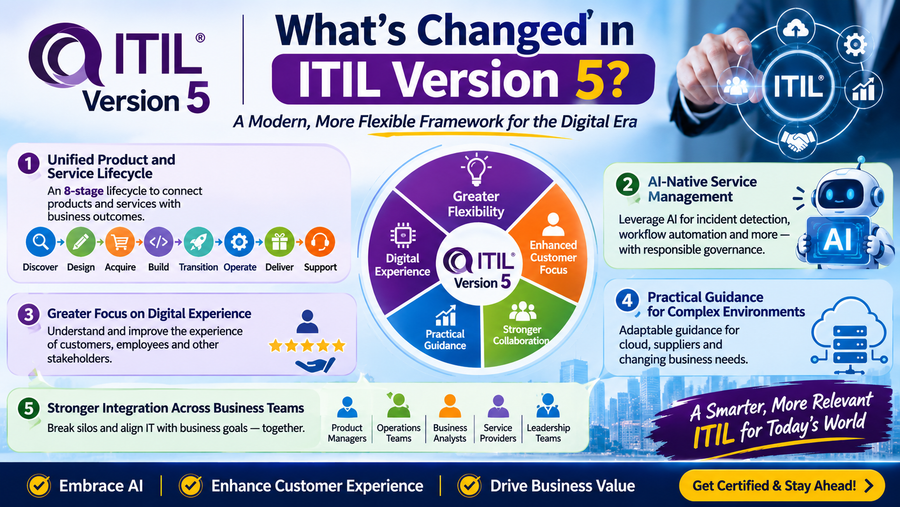
The major ITIL Version 5 changes reflect how modern businesses develop, operate, and improve digital technology.

1. Unified Product and Service Lifecycle

One of the most significant improvements is the introduction of an eight-stage Product and Service Lifecycle Model.

The stages are:

  1. Discover: Understand stakeholder needs, opportunities, and desired outcomes.
  2. Design: Plan products and services that address those requirements.
  3. Acquire: Obtain the resources and capabilities required.
  4. Build: Develop or configure solutions.
  5. Transition: Prepare solutions for operational use.
  6. Operate: Manage products and services in production environments.
  7. Deliver: Provide value through products and services.
  8. Support: Help users and address operational issues.

These activities are interconnected rather than a rigid sequence that every organization must follow.

Consider an Indian e-commerce platform launching a mobile application. Development teams build the application, infrastructure teams maintain availability, and support teams resolve customer issues. The unified lifecycle helps connect these responsibilities around consistent business outcomes.

2. AI-Native Service Management

Artificial intelligence now supports incident detection, customer assistance, workflow automation, and performance monitoring. ITIL Version 5 recognizes these capabilities while emphasizing responsible decision-making and governance.

For example, an AI-powered service desk might automatically categorize support requests. However, organizations must still manage errors, privacy concerns, escalation procedures, and accountability.

The framework helps professionals understand how AI-enabled operations can support service quality without eliminating necessary human oversight.

3. Greater Focus on Digital Experience

A technically functional service does not always deliver a positive customer experience. An application may achieve high availability while remaining difficult to navigate or slow to complete essential tasks.

ITIL Version 5 places greater emphasis on understanding the experience of customers, employees, and other stakeholders. The updated qualification scheme also includes ITIL Experience, which explores how organizations manage and improve experiences across digital products and services.

4. Practical Guidance for Complex Environments

Modern organizations frequently work across cloud platforms, third-party suppliers, distributed teams, and changing business requirements. ITIL Version 5 supports adaptable decision-making rather than prescribing identical processes for every organization.

Its guidance encourages experimentation, collaboration, and continual improvement according to organizational circumstances.

5. Stronger Integration Across Business Teams

IT management is no longer restricted to a centralized technology department. Product managers, operations teams, business analysts, service providers, and leadership teams all influence digital service outcomes. The updated framework promotes shared responsibilities and better alignment between technical activities and organizational priorities.

Learn ITIL Version 5 and ITIL Version 4

ITIL 4 vs ITIL Version 5: Key Differences

Understanding the relationship between the two versions is important for existing ITIL professionals.

ITIL 4

ITIL Version 5

Strong emphasis on IT service management

Integrated digital product and service management

Service Value System and service value chain

Retains value-system concepts while introducing an eight-stage product and service lifecycle

Existing guidance applicable to automation

AI-native guidance and stronger governance emphasis

Customer value and service relationships

Broader focus on customer and employee experience

Established certification structure

Updated role-aligned qualification pathways

Continual improvement and guiding principles

Retains these principles with more practical application guidance

Does ITIL Version 5 replace everything learned in ITIL 4?

No. ITIL Version 5 is an evolution rather than a complete replacement. Important concepts such as value co-creation, guiding principles, management practices, governance, and continual improvement remain relevant. Professionals with existing ITIL 4 knowledge can build on their understanding rather than start from the beginning.

Why Does ITIL Version 5 Matter for IT Professionals?

The updated framework helps professionals understand how their responsibilities connect to wider business outcomes.

Better Alignment With Digital Transformation

Organizations adopting cloud services and automation require professionals who understand more than individual technologies.

ITIL provides a shared approach for coordinating digital products, operational processes, and customer requirements.

Improved Service Quality

IT teams can apply ITIL concepts to identify recurring incidents, clarify responsibilities, manage changes, and improve service delivery.

For example, analyzing repeated application outages can help teams move from temporary fixes toward systematic improvements.

Stronger Career Development

ITIL knowledge can support professionals working in IT support, infrastructure operations, service delivery, product management, and digital transformation.Certification demonstrates familiarity with a recognized framework, although it does not guarantee employment or promotion.

More Effective Collaboration

ITIL establishes common terminology that helps technical and non-technical teams communicate.This becomes particularly useful when several departments or external suppliers contribute to the same service.

ITIL Version 5 Certification Pathways

The updated ITIL Version 5 certification scheme begins with Foundation and provides several advanced learning pathways.

ITIL Foundation (Version 5)

Foundation introduces the core concepts of digital product and service management.It is suitable for beginners and professionals who want an understanding of the updated framework.

ITIL Practice Manager

This pathway develops practical knowledge of ITIL management practices.It is relevant to professionals responsible for improving operational processes and service management capabilities.

ITIL Managing Professional

Managing Professional focuses on the effective management of digital products, services, and customer experiences.Its learning pathway includes modules such as ITIL Product, ITIL Service, ITIL Experience, and ITIL Transformation.

ITIL Strategic Leader

Strategic Leader supports professionals involved in organizational direction, governance, and digital business strategy.

ITIL AI Governance

The qualification scheme also includes an AI Governance extension module focused on responsible AI adoption, oversight, risk management, and accountability.Candidates should review the current PeopleCert qualification rules before enrolling in advanced modules.

How to Get ITIL Version 5 Certified in India

Professionals considering ITIL Version 5 certification in India can begin with the Foundation examination.

Step 1: Check Your Eligibility

ITIL Foundation (Version 5) has no mandatory prerequisite certification or professional experience requirement. This makes it accessible to fresh graduates, IT support professionals, managers, and career changers.

Step 2: Understand the Examination

PeopleCert administers the official Foundation examination.

Examination details

Requirements

Questions

40 multiple-choice questions

Duration

60 minutes

Passing score

65%

Correct answers required

26

Exam type

Closed book

Prerequisites

None

Candidates can explore supported online examination options and confirm booking requirements through PeopleCert.

Step 3: Choose Your Preparation Method

Foundation candidates can prepare independently or attend instructor-led training. Self-study may suit professionals already familiar with ITIL terminology. Structured training may help beginners understand lifecycle concepts, management practices, and practical applications.

Step 4: Study the Official Syllabus

Focus on digital product and service management, value co-creation, the four dimensions, guiding principles, lifecycle activities, and continual improvement. Use practical examples to understand how these concepts apply within organizations.

Step 5: Practise Mock Examinations

Complete timed practice tests and analyze incorrect answers. Developing a clear understanding of the framework is more useful than relying entirely on memorization.

Step 6: Book and Complete Your Examination

Register through an authorized examination channel, verify your identification requirements, and prepare your testing environment. After passing, follow PeopleCert’s instructions to access your certification records.

ITIL Version 5 Certification Cost in India

ITIL Version 5 Certification Cost in India

Certification costs depend on the examination package, learning materials, training provider, and optional services. Potential expenses include the official examination voucher, instructor-led training, mock assessments, resit options, and applicable taxes.

Because pricing changes, candidates should request current fees before purchasing. When comparing training providers, confirm whether the official examination voucher is included in the quoted package.

ITIL 5 Certification Training With Aabiance Technology

A structured learning programme can help candidates understand the updated framework and prepare systematically. Aabiance Technology offers ITIL 5 certification training through live online sessions across India and classroom options in Chennai.

The published programme includes two days of instructor-led learning, covering 16 hours across 12 modules. Training activities include four-dimensional analysis, value-stream mapping, continual improvement exercises, and scenario-based mock examinations. These activities help connect theoretical concepts with realistic IT service management situations.

Conclusion

ITIL Version 5 reflects the changing relationship between technology, digital products, customer experience, and business performance. Its unified lifecycle, AI-native guidance, and practical management principles help professionals understand how modern organizations deliver sustainable value.

For beginners, Foundation certification provides an accessible introduction. For experienced ITIL professionals, the updated framework offers opportunities to strengthen existing knowledge. If you’re planning to develop your IT service management skills, explore Aabiance Technology’s ITIL Foundation Version 5 training and choose a preparation pathway aligned with your professional goals.

FAQ

1. Is ITIL Version 5 certification available in India?

Yes. ITIL Foundation (Version 5) is an internationally available PeopleCert certification. Indian candidates can prepare through self-study or suitable training programmes and explore online-proctored examination options. Always confirm the latest booking and identification requirements before registering.

2. Is ITIL Version 5 better than ITIL 4?

ITIL Version 5 provides updated guidance for digital product management, AI-enabled environments, and integrated service lifecycles. However, ITIL 4 knowledge remains relevant. The appropriate learning path depends on your existing certifications, professional responsibilities, and career objectives.

3. Do existing ITIL 4 certificate holders need to retake Foundation?

Not necessarily. PeopleCert recognizes qualifying ITIL 4 certifications for progression into advanced Version 5 learning pathways. An optional Foundation Bridge route is also available for eligible candidates who want to update their foundational knowledge.

4. What is the passing score for ITIL Foundation Version 5?

Candidates must achieve at least 65% in the Foundation examination. The test contains 40 multiple-choice questions and lasts 60 minutes, meaning at least 26 correct answers are required. The examination is closed book.

5. How long is ITIL Version 5 certification valid?

ITIL Version 5 certificates follow a three-year renewal cycle. PeopleCert provides renewal routes involving qualifying Continuing Professional Development, earning another relevant certification, or retaking the examination. Candidates should check the latest renewal conditions before choosing an option.

Written by

Aabiance Technology

Expert instructor and certified professional with extensive experience training working professionals for global certifications including PMP, AWS, CSM, and PSM.