Introduction
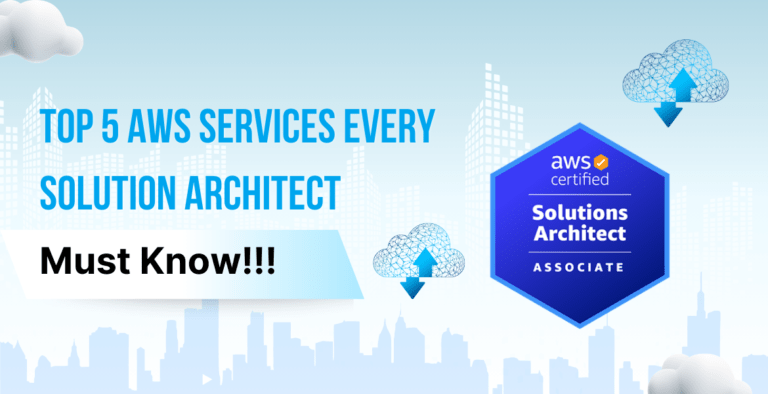
If you’re wondering whether investing time in cloud skills will actually move your career forward, here’s the short answer: yes, and AWS solution architecture is one of the fastest ways to do it. Companies everywhere are migrating workloads to the cloud, and they need people who can design systems that don’t fall over under load, don’t bleed money, and don’t get hacked. That’s exactly what a solutions architect does, and that’s why the AWS Solutions Architect Certification keeps showing up on hiring managers’ shortlists of “must-haves” for cloud roles.
Why Cloud Architecture Skills Are in Such High Demand Right Now
Enterprises aren’t asking “should we move to the cloud” anymore — they’re asking “how fast can we do it without breaking things.” That shift has created a massive skills gap. Organizations have the budget and the mandate, but not enough people who understand how to architect systems that are secure, cost-efficient, and scalable at the same time.
This is where solution architects become the glue between business goals and technical execution. A good architect doesn’t just pick services off a menu; they understand trade-offs. Should this workload run on EC2 or Lambda? Does this application need multi-region failover, or is that overkill for a small internal tool? These are the judgment calls that separate a junior engineer from someone ready to lead architecture decisions — and it’s precisely this judgment that the aws certified solutions architect credential is designed to validate.
Core Technical Skills Every Aspiring Architect Needs
Before chasing a certification, it helps to know what’s actually being tested and, more importantly, what you’ll use on the job. A few skill areas come up again and again in real projects:
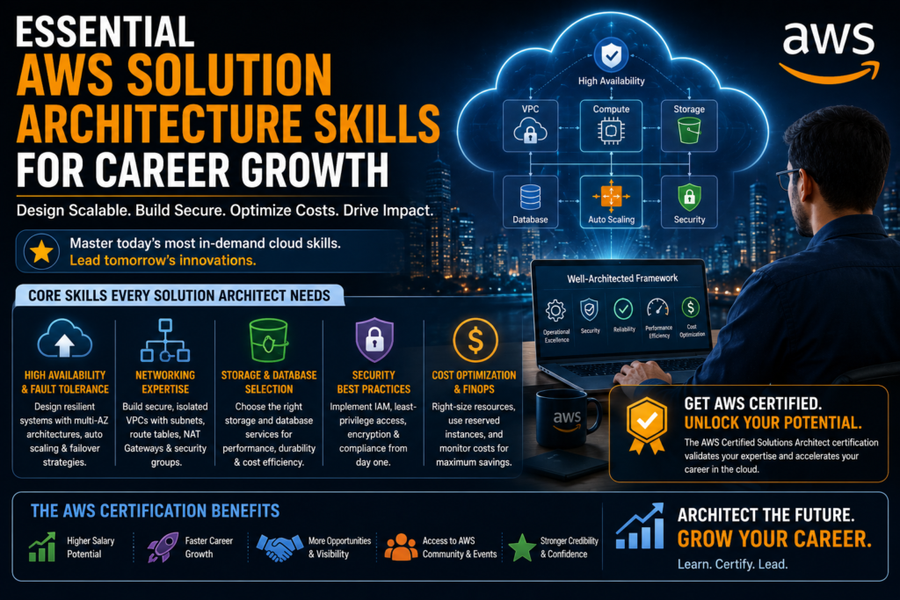
Designing for high availability and fault tolerance sits at the top of the list. You need to understand how to spread workloads across availability zones, set up auto-scaling groups, and build systems that keep running even when a single component fails. Closely related is networking — VPCs, subnets, route tables, and security groups aren’t just exam topics; they’re the plumbing that every application depends on.
Storage and database selection is another area where architects earn their keep. Knowing when to reach for S3 versus EBS, or DynamoDB versus RDS, saves companies real money and prevents performance headaches down the line. And of course, security is non-negotiable. IAM policies, encryption strategies, and least-privilege access models are things you’ll be expected to get right from day one, not something you learn after an incident.
Cost optimization deserves its own mention because it’s often overlooked by newer engineers. Understanding pricing models, reserved instances, and right-sizing resources is a skill that directly impacts a company’s bottom line — and it’s exactly the kind of thing that gets noticed by leadership.
How Certification Turns Raw Skills Into Career Currency
Having the skills is one thing; proving them to an employer or client is another. This is where formal credentials do a lot of heavy lifting. Recruiters scanning hundreds of resumes don’t have time to interview everyone to gauge their cloud knowledge, so a recognized certification acts as a fast, trustworthy filter.
The AWS certification benefits go beyond just getting past resume screening software. Certified professionals often report faster promotions, stronger negotiating positions during salary discussions, and more invitations to work on high-visibility projects. It also signals to your current employer that you’re serious about growing within the cloud practice rather than treating it as a side interest.
There’s also a community and networking angle that’s easy to underestimate. Certified professionals get access to AWS forums, local user groups, and sometimes invite-only events where deals, partnerships, and job leads circulate long before they hit public job boards.
Design Scalable, Build Secure, Optimize Costs, Drive Impact
Difference Between AWS Certification Levels
Certification Level | Best For | Focus Area | Typical Experience Needed |
AWS Certified Cloud Practitioner | Beginners, non-technical roles | General cloud concepts | None to minimal |
AWS Certified Solutions Architect – Associate | Engineers moving into architecture roles | Designing resilient, cost-effective systems | 1 year hands-on AWS |
AWS Certified Solutions Architect – Professional | Senior architects, technical leads | Complex, multi-account, enterprise architecture | 2+ years architecting on AWS |
AWS Certified DevOps Engineer | Automation and CI/CD focused roles | Deployment pipelines, monitoring | Associate-level AWS knowledge |
Practical Ways to Build These Skills Beyond Studying for an Exam
Passing a certification exam and being a genuinely capable architect aren’t always the same thing, which is why hands-on practice matters so much. Spinning up your own projects — a serverless web app, a data pipeline, or a simple three-tier architecture — teaches you things no practice test can. You start noticing details like how IAM roles interact across services, or why a Lambda function suddenly hits a timeout under load.
Contributing to open-source infrastructure projects or volunteering to lead a small migration at work are other ways to build real credibility. Employers value people who’ve made mistakes and fixed them far more than people who only know the theory. If your current role doesn’t offer cloud exposure, consider building a portfolio project and documenting the architecture decisions you made and why — this becomes a powerful talking point in interviews.
Staying current matters too. AWS releases new services and updates existing ones constantly, so following AWS “What’s New” announcements, re: Invent session recordings, and community blogs keeps your knowledge from going stale between certification renewal cycles.
Turning Certification Into Long-Term Career Growth
Getting certified isn’t the finish line — it’s the credibility marker that opens doors to bigger responsibilities. Once you’re recognized as an AWS Certified Solutions Architect, the natural next step is applying that knowledge to increasingly complex problems: multi-account governance, hybrid cloud setups, or cost governance across dozens of teams.
Many professionals use their first certification as a springboard into specialized paths like security, machine learning, or networking specialties on AWS. Others move into architect or technical lead titles within 12–18 months of certifying, especially if they pair the credential with visible project contributions at work. The key is treating certification as proof of a baseline, then continuously stacking real project experience on top of it.
Final Thoughts
Cloud architecture isn’t a passing trend — it’s become core infrastructure for how modern businesses operate. Building the skills behind the AWS Solution Architect certification, and backing them up with real project experience, positions you for roles that are both well-compensated and genuinely interesting. The AWS Certification Benefits credibility, career mobility, and access to a strong professional network, which compound over time, especially when paired with continuous hands-on learning.
Written by
Aabiance Technology
Expert instructor and certified professional with extensive experience training working professionals for global certifications including PMP, AWS, CSM, and PSM.