Introduction
DevOps is more than a collection of tools. It is a culture that encourages collaboration, automation, continuous integration, continuous delivery, and continuous improvement throughout the software development lifecycle. Organizations worldwide are investing heavily in DevOps because it enables faster releases, better software quality, reduced downtime, and improved customer satisfaction.
If you’re considering a career in cloud computing or software engineering, understanding DevOps is essential. Professionals often strengthen their DevOps expertise by pursuing AWS Solution Architect certification, attending AWS classes in Chennai, or enrolling in AWS courses in Chennai to gain practical cloud knowledge
Understanding DevOps: More Than Just Automation
DevOps is a combination of “Development” and “Operations.” It promotes collaboration between software developers, testers, operations engineers, and security teams to deliver software faster while maintaining reliability and quality.
Instead of treating development and operations as separate departments, DevOps encourages shared responsibility throughout the entire software lifecycle.
The primary goals of DevOps include:
- Faster software delivery
- Improved collaboration
- Reduced deployment failures
- Automated workflows
- Better system reliability
- Continuous feedback
- Higher customer satisfaction
Today’s organizations rely on DevOps practices to remain competitive in an increasingly digital marketplace.
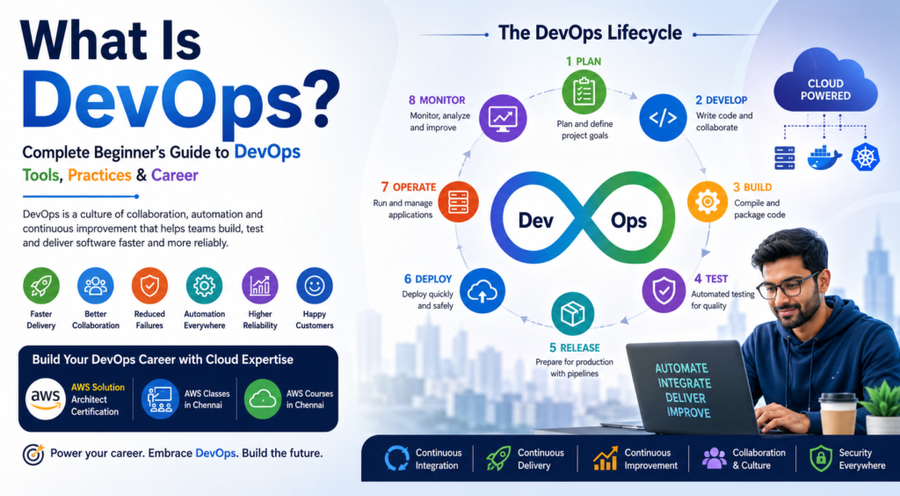
The DevOps Lifecycle Explained
DevOps follows a continuous cycle where every phase contributes to faster and more reliable software delivery.
Plan
Teams gather requirements, prioritize work, and define project goals before development begins.
Develop
Developers write code while collaborating closely with testers and operations teams.
Build
Source code is compiled and packaged using automated build tools.
Test
Automated testing validates functionality, performance, and security before deployment.
Release
Applications are prepared for production using standardized deployment pipelines.
Deploy
Automated deployment tools deliver applications quickly while minimizing downtime.
Operate
Infrastructure and applications are continuously monitored to maintain availability.
Monitor
Teams analyze logs, system performance, and user feedback to improve future releases.
This continuous feedback loop enables organizations to deliver software updates more efficiently than traditional development approaches.
Popular DevOps Tools Every Beginner Should Know
DevOps professionals use a wide range of tools depending on organizational requirements.
Some of the most commonly used technologies include:
Category | Popular Tools |
Version Control | Git, GitHub, GitLab |
CI/CD | Jenkins, GitHub Actions, Azure DevOps |
Containers | Docker |
Container Orchestration | Kubernetes |
Infrastructure as Code | Terraform, Ansible |
Monitoring | Prometheus, Grafana |
Cloud Platforms | AWS, Microsoft Azure, Google Cloud |
Among these, AWS remains one of the most widely adopted cloud platforms, making the AWS Solutions Architect Certification an excellent complement to DevOps expertise.
What Is DevOps? Complete Beginner's Guide to DevOps Tools, Practices & Career
Why AWS Knowledge Is Important for DevOps Professionals
Modern DevOps teams frequently build and deploy applications on cloud platforms. AWS provides scalable infrastructure, automation services, networking, storage, monitoring, and security solutions that align perfectly with DevOps practices.
Professionals pursuing AWS Solutions Architect certification gain valuable knowledge about designing cloud-native applications, implementing scalable architectures, and managing cloud infrastructure efficiently.
Many aspiring engineers also enroll in AWS classes in Chennai or AWS courses in Chennai to gain hands-on experience with AWS services commonly used in DevOps environments.
Some of the most significant AWS certification benefits include improved technical credibility, enhanced career opportunities, stronger cloud expertise, and better salary prospects in cloud and DevOps roles.
DevOps vs Traditional Software Development
Feature | Traditional Development | DevOps |
Team Structure | Separate development and operations teams | Collaborative cross-functional teams |
Deployment Frequency | Infrequent | Continuous |
Automation | Limited | Extensive |
Testing | Mostly manual | Automated |
Feedback | Delayed | Continuous |
Release Speed | Slow | Fast |
Infrastructure | Mostly manual | Automated using Infrastructure as Code |
This comparison illustrates why organizations increasingly adopt DevOps to improve software quality and accelerate innovation.
Essential Skills for a DevOps Career
A successful DevOps engineer combines technical expertise with collaboration and problem-solving skills.
Key technical skills include:
- Linux administration
- Networking fundamentals
- Cloud computing
- Docker
- Kubernetes
- CI/CD pipelines
- Infrastructure as Code
- Monitoring and logging
- Scripting using Python or Bash
- Security best practices
Alongside technical capabilities, communication, teamwork, adaptability, and continuous learning are equally important for long-term success.
Career Opportunities in DevOps
DevOps continues to rank among the fastest-growing career paths in the technology industry. Organizations across finance, healthcare, e-commerce, manufacturing, telecommunications, education, and government actively recruit DevOps professionals.
Popular job roles include:
- DevOps Engineer
- Cloud Engineer
- Platform Engineer
- Site Reliability Engineer (SRE)
- Automation Engineer
- Infrastructure Engineer
- Cloud Solutions Architect
- Release Engineer
Professionals who combine DevOps expertise with AWS Solutions Architect certification often qualify for more advanced cloud engineering and architecture roles.
How to Start Your DevOps Journey
Starting a DevOps career doesn’t require mastering every tool at once. A structured learning path can make the journey much easier.
Begin by understanding Linux, networking, and version control systems like Git. Next, learn cloud computing concepts, containerization with Docker, Kubernetes orchestration, and CI/CD pipelines.
Hands-on practice is essential. Building personal projects and experimenting with cloud services help reinforce theoretical knowledge.
Many learners choose AWS classes in Chennai or comprehensive AWS courses in Chennai because they provide practical cloud experience that complements DevOps learning.
Additionally, one of the greatest AWS certification benefits is gaining industry-recognized validation of your cloud expertise, making your resume more attractive to employers.
Conclusion
DevOps has transformed the way organizations develop, test, deploy, and maintain software. By fostering collaboration, embracing automation, and enabling continuous delivery, DevOps helps businesses innovate faster while maintaining reliability and quality.
For beginners, learning DevOps opens the door to exciting career opportunities across cloud computing, automation, software engineering, and infrastructure management. Combining DevOps expertise with AWS Solution Architect certification or AWS Solutions Architect certification can significantly enhance your career prospects. Whether you’re exploring AWS classes in Chennai, enrolling in AWS courses in Chennai, or seeking the long-term AWS certification benefits, investing in cloud and DevOps skills is a smart step toward building a successful technology career.
FAQ
1. What is DevOps in simple terms?
DevOps is a collaborative approach that combines software development and IT operations to automate processes, improve teamwork, and deliver software more efficiently.
2. Is DevOps a good career for beginners?
Yes. DevOps offers excellent career opportunities for beginners who are willing to learn cloud computing, automation, Linux, and modern software delivery practices.
3. Why is the AWS Solution Architect certification useful for DevOps professionals?
An AWS Solution Architect certification helps professionals understand cloud architecture, infrastructure design, and AWS services widely used in DevOps environments.
4. What is the difference between AWS Solution Architect certification and AWS Solutions Architect certification?
Both terms generally refer to AWS architecture-focused certification paths that validate cloud design and implementation skills. Many learners use these phrases interchangeably while searching for certification information.
5. Are AWS classes in Chennai suitable for beginners?
Yes. Many AWS classes in Chennai provide beginner-friendly training with practical labs, instructor guidance, and certification preparation.
6. How do AWS courses in Chennai support a DevOps career?
Quality AWS courses in Chennai teach cloud services, networking, storage, security, and automation concepts that are essential for DevOps professionals.
7. What are the major AWS certification benefits?
Some important AWS certification benefits include higher credibility, improved employability, stronger cloud expertise, increased salary potential, and better opportunities in cloud and DevOps roles.
8. Which DevOps tools should beginners learn first?
Beginners should start with Git, Linux, Docker, Jenkins, Kubernetes, Terraform, and AWS cloud services before progressing to advanced automation and monitoring tools.
Written by
Venkat Raman
Expert instructor and certified professional with extensive experience training working professionals for global certifications including PMP, AWS, CSM, and PSM.