Introduction
Choosing the right cloud career path can be confusing, especially when both AWS Solution Architect and Cloud Engineer roles offer strong job opportunities in Chennai. Many students, freshers, IT professionals, system administrators, support engineers, and career switchers want to enter cloud computing but are unsure which course to choose first. Should you join an AWS Solution Architect course or a Cloud Engineer course? The answer depends on your current skills, career goals, and the type of work you want to do. If you enjoy designing cloud solutions, planning architecture, and working with business requirements, an AWS Solution Architect can be the right path. If you enjoy hands-on work, deployments, troubleshooting, servers, Linux, automation, and cloud operations, a Cloud Engineer can be the better choice.
AWS Solution Architect vs Cloud Engineer: Quick Career Difference
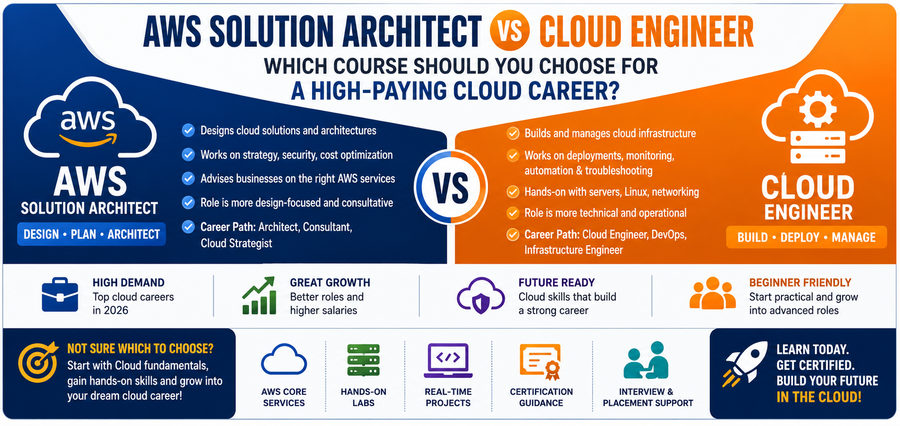
An AWS Solution Architect designs cloud solutions.
A Cloud Engineer builds and manages cloud infrastructure.
An AWS Solution Architect focuses on cloud architecture, security design, cost planning, migration strategy, and choosing the right AWS services.
A Cloud Engineer focuses on server setup, deployments, monitoring, automation, networking, troubleshooting, and cloud maintenance.
So, before joining AWS certification training, you should first understand whether you want a design-focused career or a hands-on technical career.
Who Should Choose AWS Solution Architect Training?
You should choose AWS Solution Architect training if you want to work in a role that involves planning, designing, and advising businesses on cloud solutions.
This course is suitable for:
Freshers who want to enter cloud architecture gradually
IT professionals who want to move into cloud consulting
Developers who want to understand AWS architecture
System administrators who want career growth
Project coordinators who want to move into cloud roles
Working professionals who want a better-paying cloud career
In this path, you will learn AWS services, cloud architecture, networking, security, databases, migration, cost optimisation, and the AWS Well-Architected Framework.
Who Should Choose Cloud Engineer Training?
You should choose Cloud Engineer training if you want to work directly with cloud infrastructure and real-time cloud operations.
This course is suitable for:
Freshers who want practical cloud jobs, Technical support engineers, System administrators, Network engineers, Linux administrators, DevOps beginners, IT professionals who like hands-on work, Students who want job-ready cloud skills
A Cloud Engineer course usually covers AWS core services, Linux basics, networking, EC2, S3, IAM, VPC, RDS, CloudWatch, AWS CLI, Terraform, Docker, CI/CD, and troubleshooting.
Which Course Is Better for Freshers?
For freshers, the Cloud Engineer path is usually easier to start with because it gives more hands-on practical experience. Many companies prefer freshers for cloud support, junior cloud engineer, technical support, and infrastructure roles before moving them into architecture roles.
However, freshers can still learn AWS Solution Architect concepts along with practical cloud engineering skills.
The best option is to choose a course that includes both:
AWS core services, Cloud infrastructure practice, Real-time projects, AWS architecture basics
Linux and networking, Deployment practice, Interview preparation, Resume building, Placement support
This gives you better job readiness than learning only theory.
Best AWS Course in Chennai: What Should It Include?
Before joining the best AWS course in Chennai, check whether the training includes practical learning, not just recorded videos or theory.
A good AWS course should include:
AWS account setup, EC2 server creation, S3 storage practice, VPC and networking labs, IAM user and role management, RDS database setup, Load balancer and auto scaling, CloudWatch monitoring, AWS CLI practice, Terraform basics, Docker and CI/CD introduction, Real-time cloud projects, Resume preparation, Mock interviews, Certification guidance, Placement assistance
If the course does not include hands-on labs and projects, it may not help you become job-ready.
Which Career Should You Choose?
Choose AWS Solution Architect if:
You like planning and designing
You want a senior cloud role in the future
You are interested in architecture and consulting
You enjoy business and technical communication
You want to work with a cloud strategy
Choose Cloud Engineer if:
You like practical technical work
You want to enter cloud jobs faster
You enjoy Linux, networking, servers, and troubleshooting
You want hands-on AWS infrastructure skills
You are interested in DevOps in the future
For most beginners, the best choice is to start with Cloud Engineer training and slowly move towards AWS Solution Architect certification after gaining hands-on knowledge.
What Makes the Right AWS Training Institute Different?
The right training institute not only teaches AWS services. It helps you become job-ready.
A strong AWS training program should offer:
Practical lab sessions, Real-time cloud projects, Trainer-led learning, Doubt-clearing support, Certification preparation, Interview training, Resume support, Placement guidance, Flexible batches, Career counselling
This is what separates a normal course from a career-focused AWS training program.
Conclusion
Both AWS Solution Architect and Cloud Engineer are strong career options in 2026. If you want a practical entry-level cloud job, start with a Cloud Engineer course. If you want to grow into architecture, consulting, and cloud design roles, choose an AWS Solution Architect course.
The smartest path is to learn AWS fundamentals, gain hands-on cloud engineering skills, complete AWS certification training, build real-time projects, and then move towards advanced architecture roles.
Before joining any course, check the syllabus, trainer experience, practical labs, project support, certification guidance, and placement assistance. The right course can help you build a strong cloud career in Chennai.
FAQs
1. Which is better: the AWS Solution Architect course or the Cloud Engineer course?
Both are good. Choose AWS Solution Architect if you like design and planning. Choose Cloud Engineer if you like hands-on technical work and cloud operations.
2. Which AWS course is best for freshers?
For freshers, a Cloud Engineer course with AWS basics, Linux, networking, projects, and placement support is a good starting point.
3. Can I become an AWS Solution Architect without experience?
You can learn the concepts and complete certification, but most architect roles prefer practical cloud experience. Start with hands-on AWS projects first.
4. Is AWS training with placement useful?
Yes. AWS training with placement is useful if it includes resume support, mock interviews, project preparation, certification guidance, and job referrals.
5. What should I learn first for cloud jobs?
Start with cloud basics, Linux, networking, AWS core services, IAM, EC2, S3, VPC, RDS, CloudWatch, and basic deployment projects.
6. Is coding required for AWS cloud jobs?
Advanced coding is not mandatory for all AWS roles. But basic scripting, Linux commands, YAML, Terraform, and Python basics can improve your job opportunities.
7. Which AWS certification should I take first?
Beginners can start with AWS Cloud Practitioner or directly prepare for AWS Certified Solutions Architect Associate if they have basic cloud knowledge.
8. Which city is best for AWS jobs in Chennai?
Bangalore, Hyderabad, Chennai, Pune, Mumbai, Delhi NCR, and Coimbatore have good AWS and cloud computing job opportunities.
9. How long does it take to complete an AWS course?
A practical AWS course usually takes 2 to 4 months depending on syllabus, lab practice, projects, and certification preparation.
10. How do I choose the best AWS course in Chennai?
Choose a course that includes practical labs, real-time projects, certification support, interview preparation, resume support, and placement assistance.
Ready to Start Your AWS AI Certification Training Journey? Reach Out Today
Written by
Venkat Raman
Expert instructor and certified professional with extensive experience training working professionals for global certifications including PMP, AWS, CSM, and PSM.