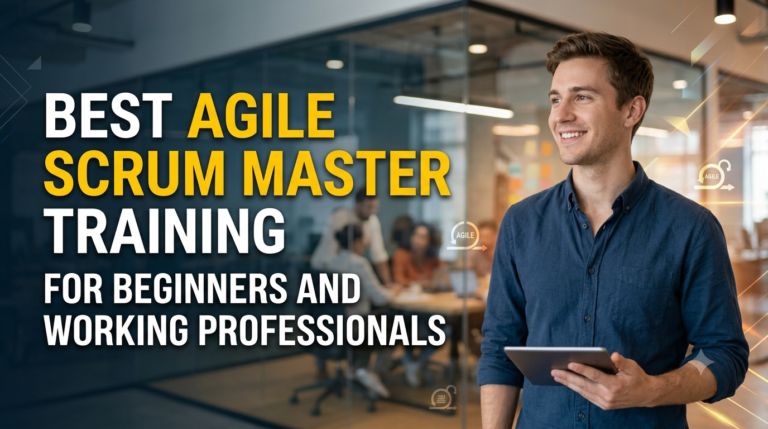

In an Agile team, the Scrum Master often acts as the silent force behind the scenes clearing blockers, fostering collaboration, and driving continuous improvement. While team members may carry out the actual development work, it’s the Scrum Master who ensures that processes, priorities, and people stay aligned toward delivery goals.
If you’re aiming to become the catalyst for high-performing Agile teams, consider starting your journey with a Scrum master certification online. Certification gives you more than just theory it equips you with real-world tools to drive transformation.

Who is a Scrum Master?
A Scrum Master is a servant leader and facilitator within an Agile team. Unlike traditional project managers, they don’t assign tasks or track hours. Instead, they:
- Coach the team on Agile principles
- Ensure Scrum ceremonies are productive (standups, retros, sprint planning)
- Remove obstacles that block progress
- Facilitate communication between stakeholders and team
- Encourage a culture of ownership, autonomy, and collaboration
In short, the Scrum Master is the engine oil of the Agile machine—unseen but essential.
1. Scrum Masters Eliminate Obstacles Before They Become Problems
Agile teams move fast—and friction slows them down. Scrum Masters proactively identify bottlenecks, whether it’s an unclear requirement, a blocked deployment pipeline, or unresolved conflict between members.
When trained at the best scrum master training institute, professionals learn to anticipate risks early and act swiftly. They leverage tools like Jira dashboards, burn-down charts, and retrospectives to track velocity and identify slowdowns before they hurt delivery.
2. They Enable a Culture of Transparency and Trust
Scrum Masters act as neutral facilitators, ensuring every voice in the team is heard. By leading retrospectives and daily standups, they encourage open conversations on what’s working and what isn’t.
This builds a psychologically safe environment—where people aren’t afraid to raise concerns or admit mistakes. That transparency is the foundation of trust, and trust is the foundation of team success.
3. They Align Teams to Agile Values and Customer Goals
Every successful Agile team needs someone who champions the why behind the what. Scrum Masters keep the team anchored to:
- Customer priorities
- Agile principles (collaboration, responsiveness, simplicity)
- Business outcomes, not just technical features
This is especially critical when teams get lost in complex builds or diverging stakeholder inputs. A Scrum Master, empowered through agile scrum master coaching, knows how to steer teams back on course without micro-managing.
Want to become the reason your team succeeds?
Get started with expert-led, globally recognized
4. They Strengthen Collaboration Across Roles
The Scrum Master ensures that developers, testers, designers, product owners, and even external stakeholders stay connected. They facilitate smooth handoffs, ensure backlog refinement sessions are productive, and resolve misunderstandings early.
Without this bridge, Agile teams often fall into silos. The Scrum Master brings everyone together—like a conductor aligning instruments in an orchestra.
5. They Promote Continuous Learning and Improvement
The best teams don’t just execute—they evolve. Scrum Masters lead sprint retrospectives to reflect on what went well, what didn’t, and what can be improved.
They turn lessons into action items and embed change into the next sprint. This culture of Kaizen (continuous improvement) is what separates average teams from elite ones.
Through agile scrum master coaching, professionals learn how to foster this environment using real tools, real case studies, and proven facilitation techniques.
6. They Keep the Team Focused and Aligned
It’s easy for Agile teams to lose focus amid changing client requests, unexpected bugs, or pressure from management. Scrum Masters shield the team from noise and prioritize backlog items based on value, not politics.
By maintaining Scrum discipline, they ensure every sprint stays outcome-focused. This discipline, when done right, enables predictable delivery, higher quality, and less burnout.
7. They Champion Agile Transformation in the Organization
Scrum Masters don’t just serve their teams—they’re often change agents within the larger company. They:
- Advocate for Agile practices to leadership
- Coach other departments (marketing, HR) on Agile principles
- Align multiple teams in scaled environments
As a result, organizations that invest in Scrum Masters often experience faster Agile adoption and cross-team synergy.
8. They Enable Faster Time-to-Market
Agile thrives on speed. Scrum Masters reduce the time wasted on rework, miscommunication, and unnecessary meetings.
By enforcing clear definitions of “done,” planning realistic sprints, and facilitating effective demos, Scrum Masters help teams deliver working software faster—without compromising quality.
9. They Help Teams Become Self-Managing
Ironically, great Scrum Masters aim to make themselves less necessary over time.
Their coaching builds maturity in teams so they can:
- Own their deliverables
- Make decisions independently
- Improve without external prompting
This self-sufficiency is the hallmark of a high-performing Agile team, and a skilled Scrum Master is the catalyst behind it.
10. They’re Trained to Handle Complexity
Scrum Masters are trained not just to facilitate, but to handle real-world challenges like:
- Multiple product owners
- Conflicting stakeholder priorities
- Technical debt vs feature delivery
- Scaling teams across geographies
- Burnout and resource reshuffling
Programs like Scrum master certification online prepare professionals with the frameworks, soft skills, and facilitation techniques to address these scenarios with confidence.
Final Thoughts: Your Team Deserves a Scrum Master
Behind every productive, empowered, and outcome-driven Agile team is a Scrum Master—guiding without controlling, enabling without enforcing.
If you’re looking to grow as a leader, facilitator, or change agent in Agile teams, it’s time to invest in formal scrum master training.
Whether you’re a developer transitioning into leadership or a project manager adapting to Agile, the Scrum Master role is a career accelerator and a team multiplier.
Written by
Venkat Raman
Expert instructor and certified professional with extensive experience training working professionals for global certifications including PMP, AWS, CSM, and PSM.